There’s a belief in Northern Ireland that skin cancer is a problem for people who holiday in the Mediterranean, not for those of us who spend most of the year under cloud. It’s a comfortable idea and it’s wrong.
Skin cancer is the most common cancer in Northern Ireland, making up over 31% of all cancer cases. Around 4,361 people develop it here every year and roughly 399 of those are malignant melanoma, the most serious form. Melanoma rates have risen sharply over three decades, from an average of about 103 cases a year in the mid-1980s to nearly 400 now.
Habits here aren’t helping. A survey by the charity Melanoma Focus found that 34% of people in Northern Ireland rarely or never use sunscreen in the UK and only 12% said they always do. Around two thirds burn at least once a year and 27% have used sunbeds.
The good news is that skin cancer, caught early, is one of the most treatable cancers there is. This post covers what to look for, what raises your risk and what to do if something concerns you.
The Main Types of Skin Cancer
Not all skin cancers behave the same way and knowing the difference helps.
Basal cell carcinoma (BCC) is the most common by a wide margin. It grows slowly, rarely spreads elsewhere in the body and is highly treatable. It often looks like a small pearly or waxy bump, a flat scaly patch, or a sore that scabs, heals and then breaks down again in the same spot.
Squamous cell carcinoma (SCC) is the second most common. It tends to appear as a firm red lump, a scaly patch, or a persistent ulcer, often on sun-exposed areas like the face, ears, scalp, neck and backs of the hands. It grows faster than BCC and can spread if left, so it needs prompt attention.
Melanoma is much less common but far more serious, because it can spread to other organs. It usually appears as a new mole or a change in an existing one, though it can also develop on skin that looks otherwise normal. This is the one the ABCDE check below is designed to catch.
BCC and SCC together are known as non-melanoma skin cancers. They’re the reason the overall numbers are so high and survival for them is close to 100%. Melanoma survival is also good, at around nine in ten people surviving five years or more, but that figure depends heavily on catching it early.
The ABCDE Check for Moles
This is the standard way of assessing whether a mole warrants a look from a doctor. Run through it whenever you check your skin.
- A is for Asymmetry. One half doesn’t match the other.
- B is for Border. Edges are ragged, blurred or irregular rather than smooth.
- C is for Colour. More than one shade, or an uneven mix of brown, black, red, white or blue.
- D is for Diameter. Larger than about 6mm, roughly the width of a pencil eraser. Melanomas can be smaller, so don’t use size alone to rule something out.
- E is for Evolving. It’s changing. In size, shape, colour, or how it feels.
Of the five, E matters most. A mole you’ve had since childhood that has always looked slightly odd is far less concerning than one that has changed over the past few months. Change is the signal.
Other Signs Worth Checking
Melanoma gets the attention, but plenty of skin cancers don’t look like moles at all. Get anything below looked at:
- A sore or scab that hasn’t healed within four weeks, or that heals and returns in the same place
- A new lump that’s growing, particularly if it’s pearly, red, or firm
- A rough or scaly patch that persists, sometimes crusty or bleeding
- A mole that itches, stings, bleeds or feels tender
- A dark streak under a fingernail or toenail with no history of injury
- Any existing mole that’s grown noticeably or changed colour
Not all of these will be cancer. Most won’t be. But the four-week rule is a useful benchmark: anything on your skin that hasn’t settled in a month deserves a professional opinion.
Who Is Most at Risk?
Certain factors raise your risk and several are common in this part of the world.
Fair skin that burns easily. Skin that freckles, goes red rather than brown, or belongs with red or fair hair and blue or green eyes carries higher risk. That describes a lot of the population here.
A history of sunburn. Sunburn in childhood especially. Damage accumulates and blistering burns years ago still count.
Sunbed use. There’s no safe sunbed. They emit concentrated UV and are a known cause of melanoma, with the risk highest for people who started before the age of 35.
Lots of moles. More than 50 moles, or several unusual-looking ones, increases risk.
Family history. A parent, sibling or child who has had melanoma raises your own risk.
Age and cumulative exposure. Outdoor work over many years matters. Farmers, builders, groundskeepers and anyone else spending working days outside accumulate significant exposure without ever going near a beach.
A previous skin cancer. Having had one raises the odds of another, which is why follow-up checks matter.
Sun Protection in an Irish Climate
The cloud cover here does less than people assume. Up to 80% of UV radiation passes through cloud, which is why you can burn on an overcast July afternoon in Lurgan without ever seeing direct sun.
Practical points that make a difference:
- UV, not temperature, causes damage. A cool, breezy day can carry a high UV index. Check the UV forecast rather than judging by how warm it feels.
- UV is strongest between 11am and 3pm from around March to October here.
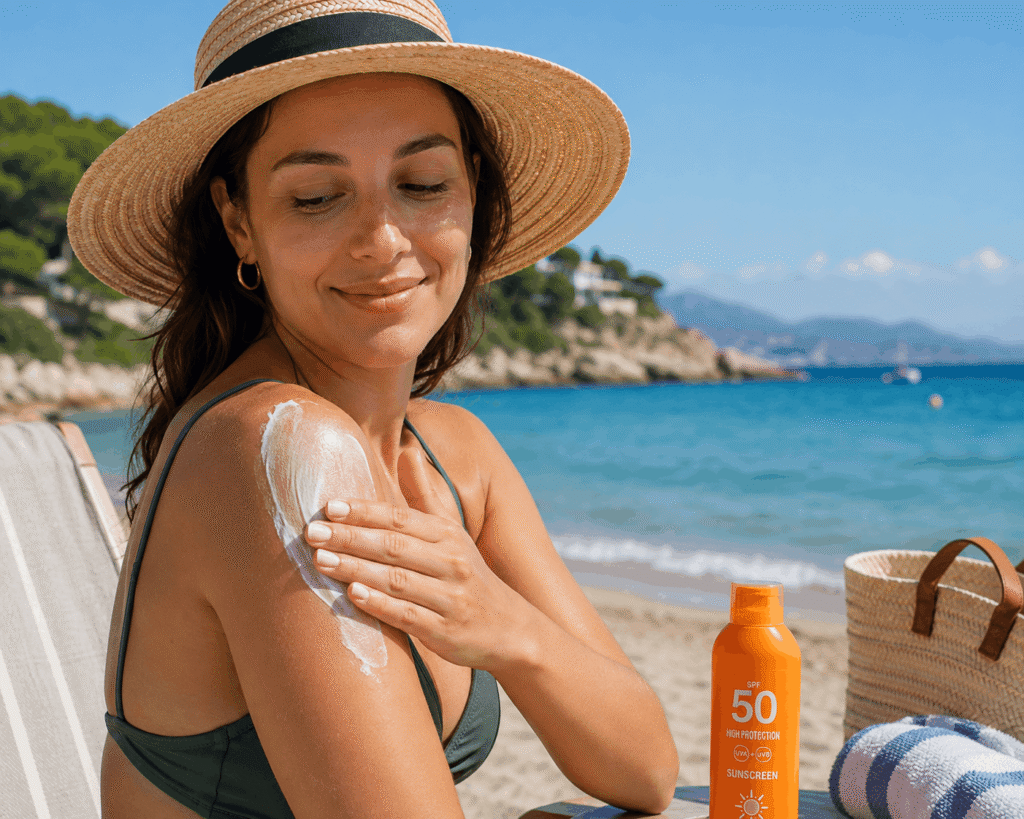
- Use SPF 30 or higher with high UVA protection and apply more than you think. Most people use around half the amount needed.
- Reapply every two hours and after swimming or sweating, regardless of what the bottle claims.
- Cover up. A wide-brimmed hat, sunglasses and a long-sleeved top do more reliable work than sunscreen alone.
- Don’t forget the missed spots. Ears, the back of the neck, the tops of feet and scalp partings are where sun damage quietly accumulates.
Care in the Sun, the Public Health Agency’s skin cancer prevention programme for Northern Ireland, has region-specific guidance worth reading.
How to Check Your Own Skin
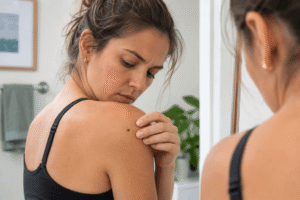
A monthly self-check takes a few minutes and is the single most useful habit for catching something early.
Use a well-lit room and a full-length mirror, with a hand mirror for the parts you can’t see. Work systematically: face, ears, neck, scalp, then torso front and back, then arms including underneath and between fingers, then legs, then feet including soles and between toes. Ask someone to check your back and scalp, since those are the areas people miss and where melanoma is often found late in men.
Photograph anything you’re unsure about, with something for scale beside it, such as a coin or a ruler. Comparing photographs a month apart is far more reliable than memory for spotting change.
When to See a Doctor
Book an appointment if a mole meets any of the ABCDE criteria, if you have a sore that hasn’t healed in four weeks, if a spot bleeds, itches or is changing, or if something new has appeared and is growing.
Don’t wait to see if it settles on its own. The overwhelming majority of lesions checked turn out to be harmless and no doctor will think you wasted their time. The cost of checking something benign is one appointment. The cost of leaving a melanoma is considerably higher.
A word of caution about removal. If you’re worried about a lesion, the right first step is assessment, not removal. A suspicious lesion needs to be examined and, if removed, sent for laboratory analysis so the tissue can be properly examined. Cosmetic removal methods that destroy the tissue, such as freezing or lasering, leave nothing to test. Never use home mole removal kits or online treatments for anything you have concerns about.
How Friends Medical Service Can Help
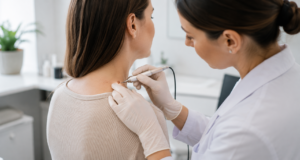
A GP appointment is the appropriate starting point for anything that concerns you. Our GP appointments are available quickly, including Saturday mornings and if a lesion needs specialist assessment or an urgent referral, that’s the route that gets you there.
For benign lesions, our minor surgical procedures service at our Lurgan clinic covers mole removal, excision of skin lesions, skin tag removal and scar revision, carried out under local anaesthetic with same-day discharge. Removed tissue can be sent for histology so you get a definitive answer rather than an assumption.
To be clear about scope: we are not a dermatology or skin cancer treatment centre. Where a lesion is suspicious, the priority is getting you into the appropriate specialist pathway quickly rather than treating it here.
Myths vs Facts About Skin Cancer
- Myth: You can’t get skin cancer in Northern Ireland, the weather doesn’t allow it.
- Fact: Skin cancer is the most common cancer here, accounting for over 31% of all cases. Up to 80% of UV passes through cloud.
- Myth: A base tan protects you from burning.
- Fact: A tan is your skin’s response to DNA damage that has already happened. It offers a protection factor of roughly 3, which is negligible.
- Myth: Sunbeds are a safer way to tan.
- Fact: Sunbeds emit concentrated UV and are a recognised cause of melanoma. Use before the age of 35 raises melanoma risk substantially.
- Myth: Only moles turn cancerous.
- Fact: Most skin cancers are BCC and SCC, which typically appear as lumps, scaly patches or non-healing sores rather than moles.
- Myth: Dark skin means you don’t need sun protection.
- Fact: Risk is lower but not absent and skin cancer in darker skin is often diagnosed later. Melanoma can also appear on palms, soles and under nails, areas that get little sun.
- Myth: If it doesn’t hurt, it’s fine.
- Fact: Most skin cancers are painless in their early stages. Appearance and change matter more than discomfort.

Frequently Asked Questions
How do I know if a mole is dangerous?
Use the ABCDE check: asymmetry, irregular border, uneven colour, diameter over 6mm and any evolution or change. Change is the most important of the five. If a mole meets any of these, have it looked at.
How quickly should I get a changing mole checked?
Promptly, within a few weeks rather than months. Melanoma outcomes are closely tied to how early it’s caught.
Will a removed mole be tested?
Where clinically appropriate, removed tissue can be sent for histology so it can be properly examined. If you have any concern about a lesion, ask about this before agreeing to any removal method.
Can I get a mole removed for cosmetic reasons?
Yes, benign moles can be removed under local anaesthetic as a minor surgical procedure. Any lesion is assessed first and anything suspicious is directed towards the appropriate specialist pathway rather than simply removed.
Does sunscreen alone protect me?
It helps considerably, but it isn’t sufficient on its own. Most people apply too little and reapply too rarely. Shade, clothing and avoiding peak UV hours do the heavier lifting.
Do I need a GP referral to book?
No. You can book a GP appointment or a minor surgery consultation with us directly.
I’ve had a skin cancer before. Should I be checking more often?
Yes. A previous skin cancer raises the risk of another, so regular self-checks and any follow-up your specialist has recommended remain important.
Can children get skin cancer?
It’s very rare in childhood, but sunburn in childhood significantly raises risk in later life. Protecting children’s skin is one of the most effective preventive steps available.
Getting Something Checked
Most skin changes turn out to be nothing. The point of checking isn’t to worry, it’s to make sure the small number of things that do matter get caught while they’re straightforward to treat.
Final Thoughts
If something on your skin has changed, or a sore hasn’t healed in a month, book a GP appointment or get in touch with Friends Medical Service. For further reading, Cancer Research UK and the British Association of Dermatologists both publish detailed patient information.