
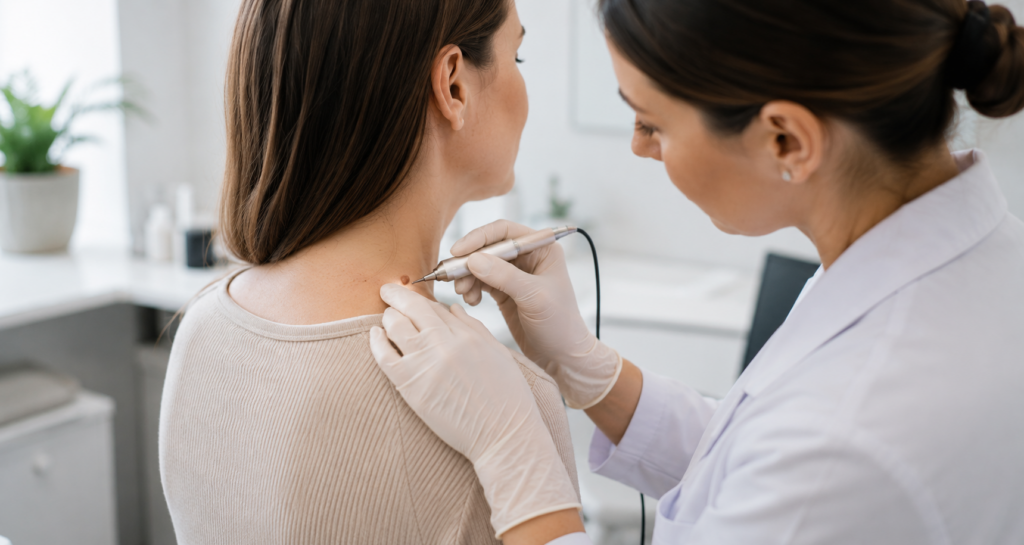
Skin tags are one of the most common reasons patients book a minor surgical procedure, yet most people live with them for years without knowing what they actually are or why they appeared. They are harmless in the overwhelming majority of cases, but their sudden appearance, their location on visible areas like the neck or the simple irritation of one catching on a necklace or collar is often enough to send someone looking for answers. This guide explains what they are, what causes them, when they are worth having checked and what to expect from private removal at Friends Medical Service in Lurgan.
What Is a Skin Tag?
A skin tag, medically known as an acrochordon and sometimes described as a cutaneous tag or flesh tag, is a small, soft growth of skin that hangs from the body on a narrow stalk. Most are a few millimetres across, though some grow larger over time. They are the same colour as the surrounding skin or slightly darker, soft to the touch and move freely when nudged.
They are extremely common. Estimates suggest that around half of all adults will develop at least one during their lifetime, with numbers increasing steadily with age. They are not contagious, they are not a form of skin cancer and having several does not indicate an underlying illness on its own. That said, certain health conditions make them more likely to appear, which is worth understanding before deciding whether removal is right for you.
What Causes Skin Tags?
The exact mechanism behind skin tags is not fully understood, but they are thought to form where skin repeatedly rubs against itself or against clothing and jewellery. This friction is thought to encourage extra skin cells to cluster together, eventually forming the small stalked growth typical of one.
Common Risk Factors
A number of factors make skin tags more likely to develop:
- Friction from skin folds, tight collars, necklaces, bra straps or waistbands,
- Age: they become noticeably more common from your 40s onwards,
- Pregnancy and hormonal changes, which can trigger new tags during and after pregnancy,
- Type 2 diabetes and insulin resistance, both linked to a higher likelihood of developing multiple tags,
- Carrying extra weight, which increases skin-on-skin friction in folds and creases, as well as
- Family history, since a tendency toward them often runs in families.
None of these factors are within a patient’s control in the way that, say, sun exposure is for skin cancer risk, so there is little you can do to prevent them from forming in the first place.
Where Do Skin Tags Commonly Appear?
They tend to cluster in areas where skin folds or rubs against fabric and jewellery:
- The neck, which is by far the most common site and is often irritated by collars and necklaces,
- The armpits and underarms,
- The eyelids and around the eyes, where removal needs particular care,
- The groin and inner thighs,
- Under the breasts and also
- The torso, back and abdomen.
Multiple tags in the same area are common. It is entirely normal to have some that are barely noticeable alongside a few larger ones that catch on clothing.
Are Skin Tags Dangerous or Can They Be Cancerous?
Skin tags themselves are benign and do not turn into skin cancer. This is one of the most common questions patients ask. The reassuring answer is that a genuine one carries no cancer risk at all.
The important caveat is that not every small growth on the skin is actually a skin tag. Moles, warts, seborrhoeic keratoses and, far more rarely, early skin cancers can all be mistaken for one at a glance. This is why any lesion that is changing in size, shape or colour, bleeding without an obvious cause such as catching on clothing, becoming crusty or simply looking different from your other tags should be assessed by a clinician rather than assumed to be harmless. Our Skin Cancer Awareness guide covers the warning signs to look out for in more detail. It is worth reading if you have any doubt about a particular lesion.
If you are unsure whether a growth is a skin tag, a mole or something else entirely, a same-day GP appointment is the quickest way to get a proper opinion before deciding on removal.
Do Skin Tags Go Away on Their Own?
Skin tags rarely disappear by themselves. Occasionally, a tag will twist on its narrow stalk, lose its blood supply, darken and eventually fall off, but this is unpredictable and can be uncomfortable while it happens. For most people, one that is there today will still be there in a year’s time unless it is removed.
When Should You Consider Skin Tag Removal?
There is no medical requirement to remove one. Removal is almost always a personal choice. It tends to be worth considering when a tag is:
- Catching repeatedly on clothing, jewellery or a razor and bleeding as a result,
- Becoming sore, inflamed or uncomfortable,
- Growing noticeably or changing in appearance,
- Positioned somewhere highly visible, such as the neck or face, or
- Affecting your confidence, even if it is not causing any physical symptoms.
Removing several tags in one appointment is usually more practical and cost-effective than returning separately for each one, so it is worth having a full assessment of everything you would like addressed before booking.

Skin Tags vs Other Common Skin Lesions
Skin tags are frequently confused with other soft lumps and bumps that Friends Medical Service also treats. The table below gives a general comparison, though any lesion should still be examined by a clinician before you assume which category it falls into.
| Lesion | Typical Feel | Typical Location | Cancer Risk |
|---|---|---|---|
| Skin tag | Soft, hangs on a narrow stalk | Neck, armpits, eyelids, groin | None |
| Mole | Flat or slightly raised, flush to the skin | Anywhere on the body | Very low, but should be monitored for change |
| Lipoma | Soft, doughy, moves under the finger | Trunk, shoulders, arms | None |
| Ganglion cyst | Firm, fluid-filled lump | Wrist, hand, foot, near joints | None |
If you are dealing with more than one type of lump at once, our broader guide to minor surgical procedures covers skin tags, lipomas, ganglion cysts and moles together and may be a useful next read.
How Skin Tag Removal Works at Our Lurgan Clinic
Private skin tag removal at Friends Medical Service is a short minor-surgery appointment carried out by an experienced clinician rather than a technician, with the tissue sent for testing if there is any clinical reason to check it.
Your Consultation
A clinician examines each tag to confirm what it is before anything else happens. You will discuss how many tags you would like removed and where. You will be given a clear, confirmed price before you commit to anything.
The Procedure
Removal is carried out under local anaesthetic, so the area is completely numb throughout. A single skin tag typically takes only a few minutes to remove. Several can often be treated in the same appointment, which is one of the reasons patients choose to deal with all of their tags at once rather than one at a time.
Aftercare and Recovery
A small dressing is applied and you are given straightforward aftercare advice to take home. Most people return to their normal daily activities the same day. Healing is generally quick, with minimal marking left behind on smaller tags.
Skin Tag Removal Cost
Pricing for skin tag removal depends on how many tags are being treated and where they are located on the body, so an exact cost is always confirmed at your consultation before the procedure goes ahead. Prices are for guidance only and will depend on the approach your clinician recommends. Removing multiple tags together in a single visit is generally more cost-effective than booking separate appointments for each one.
Why Choose Friends Medical Service
- Procedures carried out by experienced clinicians, including our Consultant General Surgeon Mr Muhammad Yousuf and our Consultant Plastic Surgeon Mr Abid Rashid,
- No long waiting lists, with appointments usually available quickly,
- Clear, up-front pricing agreed before any procedure goes ahead,
- ISO 9001, 14001 and 27001 accredited at our Lurgan site, as well as
- Rated 4.96 out of 5 by verified patients on Doctify.
Our full range of minor surgical procedures is carried out from our Lurgan clinic, which serves patients across Craigavon, Belfast, Portadown, Lisburn, Banbridge, Armagh and the wider Northern Ireland area. We also welcome cross-border patients from the Republic of Ireland for this and all of our other services.

Frequently Asked Questions
What is a skin tag?
A skin tag is a small, soft, harmless growth of skin that hangs from a narrow stalk. It is also known medically as an acrochordon and less formally as a cutaneous tag or flesh tag. They commonly appear on the neck, armpits, eyelids and groin. They are not contagious or a sign of a serious health problem.
What causes skin tags?
Skin tags are thought to form where skin repeatedly rubs against itself, clothing or jewellery. They become more common with age and are more likely if you are pregnant, carrying extra weight, have type 2 diabetes or have a family history of them.
Can skin tags be cancerous?
No, a genuine skin tag is benign and does not turn into skin cancer. However, other lesions such as moles, warts and, rarely, early skin cancers can look similar to one. Any lesion that is changing, bleeding without being caught or looks different from your other tags should be examined by a clinician rather than assumed to be harmless.
Do skin tags go away on their own?
Skin tags rarely disappear on their own. Occasionally one will twist on its stalk and fall off after losing its blood supply, but this cannot be predicted and is not a reliable way to have one removed.
Does skin tag removal hurt?
Removal is carried out under local anaesthetic, so the area is numbed before the procedure begins. Most people feel little more than mild pressure during removal itself. Any post-procedure discomfort is generally minor and short-lived.
How much does skin tag removal cost?
Cost depends on how many tags are being removed and where they are on the body. Prices are for guidance only, with your exact price confirmed at consultation before anything goes ahead. Removing several tags in one appointment is usually more cost-effective than separate visits.
Will my skin tag grow back after removal?
Once a skin tag has been fully removed, that particular tag will not grow back. However, if you are prone to them due to friction, age or an underlying tendency such as insulin resistance, new tags can develop elsewhere over time.
My skin tag is red, sore or bleeding. What should I do?
A skin tag that becomes red, sore or starts bleeding, particularly without an obvious cause like catching on clothing, should be assessed by a clinician. This does not necessarily mean anything serious, but it is always worth having it checked rather than waiting.
Can I remove a skin tag myself at home?
Removing a skin tag yourself is not recommended. Large tags in particular can bleed heavily if cut or pulled off. Home removal also makes it impossible to confirm that the lesion was actually a skin tag rather than something that needed a closer look. Speak to a clinician before attempting removal of any kind.
Further Reading
If you would like to read more from independent, patient-focused sources before your consultation, the following are reputable places to start:
- nidirect: Skin Tags, Northern Ireland’s official public health information service, covering what they are and when removal may be considered
- nidirect: Skin Cancer (Melanoma), covering the signs and symptoms that should prompt a GP visit for any changing skin lesion
- British Association of Dermatologists: Patient Information Leaflets, a library of clinically reviewed leaflets on skin conditions from the UK’s leading dermatology association
These sources are useful background reading, but they are not a substitute for having a lesion examined in person by a clinician who can look at it directly.
Book Your Skin Tag Removal
If you have a skin tag (or several) that you would like assessed and removed, our clinicians at Lurgan can usually offer an appointment quickly, with a clear price agreed before any procedure goes ahead. Visit our Skin Tag Removal service page to book an appointment or contact our team if you would like to ask a question first or discuss removing multiple lesions in the same visit.