
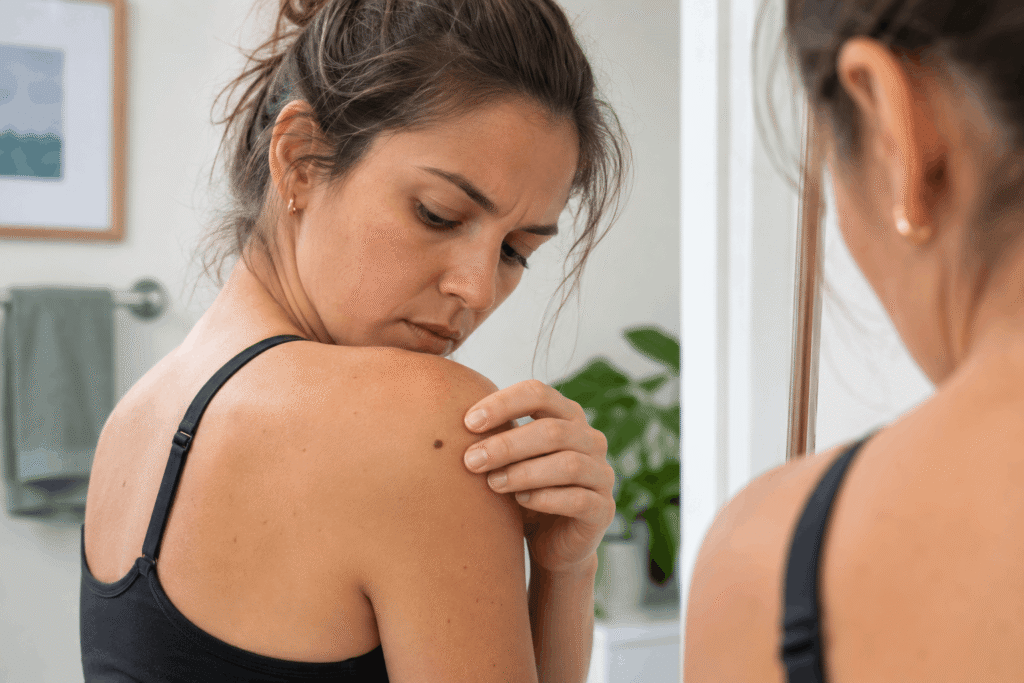
Most adults carry between ten and forty moles on their skin and the overwhelming majority never cause a moment’s concern. A small number change over time or sit somewhere that makes daily life awkward. For those moles, knowing when to get checked and what mole removal actually involves makes the whole process far less daunting. This guide covers how to screen your own skin, when a professional mole check is the right next step and what happens during private mole removal at Friends Medical Service in Lurgan.
What Is a Mole?
A mole (or naevus) is a cluster of pigment-producing cells called melanocytes that grow together in one spot on the skin. They can be flat or raised, smooth or slightly rough and range from pale brown to almost black depending on skin tone. Some are present from birth while others appear during childhood, adolescence or pregnancy. It is entirely normal for new moles to develop into your twenties and thirties, for existing moles to darken slightly during pregnancy or for some to fade as you get older.
The vast majority of moles are harmless for life. The reason mole screening matters is that a small proportion of skin cancers, particularly melanoma, can develop within an existing mole or appear as what looks like a new one.
Why Mole Screening Matters
Regular mole screening is simply the habit of knowing your own skin well enough to notice when something has changed. It costs nothing, takes a few minutes once a month and is the single most useful thing you can do between formal skin checks.
The ABCDE Checklist
Dermatologists and GPs use a simple checklist to help patients spot the features that warrant a closer look. None of these signs confirm a problem on their own, but any of them is a reasonable prompt to book a mole check.
- Asymmetry – one half of the mole looks noticeably different from the other half
- Border – the edges are ragged, notched or blurred rather than smooth
- Colour – more than one shade is present, or the colour has changed
- Diameter – the mole is larger than around 6mm, roughly the size of a pencil eraser
- Evolution – the mole is changing in size, shape, colour or texture over weeks or months
Alongside the ABCDE checklist, moles that itch, bleed, crust over or become painful without an obvious cause (such as a knock or a scrape) are also worth having assessed. The same goes for any mole that simply looks different from the others on your body, sometimes called the “ugly duckling” sign.
When to Book a Mole Check
You do not need to wait for a routine appointment to have a mole looked at. Book a mole check promptly if you notice:
- A mole that has changed size, shape or colour over recent weeks or months
- A new mole appearing in adulthood, particularly after the age of thirty
- A mole that bleeds, weeps, crusts or itches persistently
- An irregular or blurred border, or a mix of colours within one mole
- A mole that catches on clothing, jewellery or a razor and keeps being irritated
- Any spot on the skin that you simply cannot explain
None of these signs mean a mole is cancerous. They are prompts to get it examined properly rather than a diagnosis in themselves. In the great majority of cases the mole turns out to be entirely benign.
How Mole Screening Works at Friends Medical Service
A professional mole check at our Lurgan clinic starts with a clinician examining the mole or moles in question, taking a history of when they appeared and whether anything has changed. Where a mole raises no concern, you will be reassured and advised on what to keep an eye on. Where there is any doubt, we will explain the next step clearly, whether that is closer monitoring, referral for specialist assessment or removal for histology.
Patients who want a broader check of multiple moles, sometimes referred to as mole mapping, can also discuss the need for this as part of a consultation. However, please note that mole mapping itself is not a service that we provide. If your main concern is a general health review rather than a specific mole, our private GP appointment service is another route in, particularly if you want a wider skin and health assessment on the same visit.

Reasons for Mole Removal
People come to us for mole removal for two broad reasons. Both are entirely valid.
Medical Reasons
Some moles are removed because a clinician has identified a feature worth investigating further, whether that is a change in appearance, a symptom such as bleeding, or simply a mole that looks different from the rest and needs closer examination. In these cases the removed tissue is sent for histology to confirm exactly what it is.
Cosmetic Reasons
Plenty of mole removal has nothing to do with clinical concern at all. A mole that sits somewhere prominent, catches on a collar or bra strap, gets nicked while shaving or simply knocks someone’s confidence is a perfectly reasonable candidate for removal once it has been assessed as benign.
Whichever reason brings you in, assessment always comes before any decision to proceed with mole removal.
How Mole Removal Works at Our Lurgan Clinic
Minor surgical procedures including mole removal sit within our wider minor surgical procedures service, carried out by our consultant surgical team. This includes Mr Abid Rashid, a Consultant Plastic Surgeon whose areas of interest include skin cancer surgery, along with Mr Muhammad Yousuf, our Consultant General Surgeon. Both carry out minor procedures at our Lurgan clinic.
Assessment First
Every mole is examined by a clinician before any decision is made about removal. You will be advised whether removal is appropriate and which method suits the mole in question. If the mole needs a more specialist assessment before anything is done, we will tell you.
The Procedure
- Local anaesthetic is used to numb the area, so the procedure itself is not typically painful
- The mole is excised, or shave-excised where that is the more suitable technique, depending on its type and location
- The wound is closed and dressed; stitches are used where needed
- Tissue is sent for histology where clinically indicated, so you have a confirmed diagnosis rather than an assumption
Aftercare and Recovery
Most patients go home the same day with written aftercare advice covering wound care and activity to avoid while healing. Where tissue has gone for testing, your clinician will discuss the results with you directly and arrange follow-up if needed.
Facial Mole Removal
Moles on the face bring an extra consideration into the conversation: the cosmetic result matters just as much as the removal itself. Facial mole removal is approached with particular care around incision placement, technique and how the area is likely to heal, so that the outcome is as discreet as possible. Your clinician will talk through the likely appearance afterwards before you decide whether to go ahead and will give you specific advice on caring for the area while it settles.
Will Mole Removal Leave a Scar?
Any procedure that breaks the skin carries some risk of a mark. Mole removal is no exception. How noticeable the result is depends on the size and depth of the mole, its position on the body, the removal technique used and how your skin heals individually. Your clinician will be upfront with you about the likely outcome before proceeding rather than after, so there are no surprises.
Mole Removal Cost
There is no single fixed price for mole removal because so much depends on the individual case: the size of the mole, its location, the technique required and whether histology testing is needed. What you will get is a clear price agreed at your consultation before anything goes ahead, so you know exactly what you are paying for before you commit to treatment. Prices are for guidance only and depend on the procedure recommended by your consultant on the day.
Mole, Skin Tag, Lipoma or Cyst? Know the Difference
It is common to confuse a mole with other common skin and soft-tissue lumps, particularly when deciding what kind of removal is needed. The table below gives a quick reference, though a proper assessment is always the reliable way to know what you are dealing with.
| Feature | Mole | Skin Tag | Lipoma | Ganglion Cyst |
|---|---|---|---|---|
| What it is | Cluster of pigment cells | Small flap of soft skin | Soft fatty lump under the skin | Fluid-filled swelling near a joint or tendon |
| Typical appearance | Flat or raised, brown to black | Small, skin-coloured, hangs off a thin stalk | Soft, doughy, moves under the finger | Firm to soft, round, often at wrist or hand |
| Common locations | Anywhere on the body | Neck, armpits, eyelids, groin | Trunk, arms, shoulders | Wrist, hand, knee, foot |
| Usual cause for concern | Change in size, shape or colour | Rarely a medical concern | Rarely a medical concern | Growth, pain or restricted movement |
If you are not sure which of these applies to your own skin lesion, that uncertainty is exactly what a clinical assessment is for. If it turns out to be something other than a mole, we treat some of those too: read more about skin tag removal or lipoma removal.
Where to Find Us
Mole checks and private mole removal at Friends Medical Service are carried out at our clinic in Lurgan, serving patients from across Craigavon, Portadown, Lisburn, Banbridge, Armagh, Belfast and the wider Northern Ireland area. We also welcome cross-border patients from the Republic of Ireland, many of whom travel to Lurgan for private mole screening and removal.
Frequently Asked Questions
How much does mole removal cost?
Cost depends on the size, type and location of the mole, the removal method used and whether histology is required. You will be given a clear, guideline price at your consultation before any procedure goes ahead, so there is no surprise on the day.
Does mole removal hurt?
The area is numbed with local anaesthetic before the procedure begins, so most patients describe some pressure rather than pain during removal itself. There may be some tenderness for a few days afterwards while the wound settles, which is normal and manageable with simple aftercare.
Will the removed tissue be tested?
Where clinically indicated, tissue removed during mole removal is sent for histology, meaning it is examined under a microscope to confirm exactly what type of mole or lesion it was. Your clinician will discuss the results with you once they are available.
Can a mole grow back after removal?
Once a mole has been fully excised it should not return, though very occasionally some pigmented cells can remain at the edge of a wound and reappear as a smaller mark. If you notice any changes at the site of a previous removal, it is worth having it looked at again.
Can you remove moles from the face?
Yes. Facial mole removal is carried out with particular attention to technique and incision placement given how visible the area is. Your clinician will discuss the expected cosmetic outcome with you before you decide whether to proceed.
How do I know if a mole is dangerous?
No one can tell whether a mole is a concern just by looking at a description of it. The ABCDE checklist (asymmetry, border, colour, diameter, evolution) is a useful prompt for when to get a mole examined, but a proper clinical assessment is the only reliable way to know for certain.
Do I need a GP referral for private mole removal?
No. You can book a private consultation for a mole check or mole removal directly with us without going through your GP first. If our clinician identifies anything that needs specialist input beyond what we offer, we will explain the next step clearly.
Further Reading
If you’d like to read more from independent, patient-focused sources before your consultation, the following are reputable places to start:
- NHS: Moles – an overview of what moles are and how to spot the signs that a mole could need attention
- NHS: Melanoma Skin Cancer – symptoms, causes and treatment of the most serious form of skin cancer
- British Association of Dermatologists: Atypical Mole Syndrome – a patient information leaflet on moles that are larger or more irregular than usual
- Melanoma Focus: About Melanoma – guidance from the UK’s national melanoma charity on checking your skin and recognising warning signs
These sources are useful background reading and complement, rather than replace, a proper clinical assessment of your own skin.
Final Thoughts
Most moles are nothing to worry about. Knowing your own skin well enough to notice a change is the best habit you can build between check-ups. Whether you want a mole assessed because something has changed, or you simply want a mole removed for comfort or confidence, the process starts with a straightforward consultation at our Lurgan clinic.
To book a mole check or discuss private mole removal, please visit our respective mole check and mole removal service pages or get in touch with our team to arrange your appointment.