“Allied Health Professional” is a term most patients hear in passing, often on a referral letter or a hospital appointment card, without ever being told exactly what it means. An Allied Health Professional (AHP) is one of fourteen regulated healthcare roles that sit alongside doctors, nurses and pharmacists, covering everything from physiotherapy to speech and language therapy. This guide explains what the title covers, what these professionals actually do and how you can access AHP-led care privately through Friends Medical Service in Northern Ireland, without joining a National Health Service (NHS) waiting list.
What Does “Allied Health Professional” Mean?
Allied Health Professionals are the third largest clinical workforce in the NHS, after medicine and nursing. Most AHP roles are degree-level professions. Practitioners work autonomously, meaning they can assess, diagnose, treat and, in many cases, discharge a patient without a doctor overseeing every step.
Thirteen of the fourteen AHP titles are regulated by the Health and Care Professions Council (HCPC), a statutory body that sets standards of education, conduct and proficiency for the professionals on its register. The fourteenth, osteopathy, is regulated separately by the General Osteopathic Council (GOsC). Anyone using a protected AHP title, such as “physiotherapist” or “paramedic”, must be registered with the relevant regulator. You can check whether a practitioner is currently registered using the HCPC’s public “Check the Register” tool.
The 14 Allied Health Professions
The fourteen professions that fall under the AHP umbrella are:
- Art therapists (art psychotherapists): use creative activity to support mental health and emotional wellbeing.
- Dietitians: assess nutritional needs and manage diet-related health conditions.
- Dramatherapists: use drama and performance techniques as a therapeutic tool.
- Music therapists: use music to support communication, emotional and physical development.
- Occupational therapists: help people regain independence with everyday tasks after illness, injury or disability.
- Operating department practitioners: support surgical teams before, during and after operations.
- Orthoptists: diagnose and manage problems with eye movement and binocular vision.
- Osteopaths: treat musculoskeletal problems through manual therapy.
- Paramedics: deliver emergency and urgent care, often as the first clinician on scene.
- Physiotherapists: treat movement and function problems using exercise, manual therapy and rehabilitation.
- Podiatrists (chiropodists): assess and treat conditions affecting the feet and lower limbs.
- Prosthetists and orthotists: design and fit artificial limbs and supportive devices.
- Radiographers (diagnostic and therapeutic): produce diagnostic images and deliver radiotherapy treatment.
- Speech and language therapists: assess and treat communication and swallowing difficulties.
What Do Allied Health Professionals Actually Do?
Although the fourteen professions look very different on paper, they share a common approach to patient care:
- Assessment, diagnosis and treatment: most AHPs can work through the full patient journey independently, rather than acting purely on instruction from a doctor.
- Prevention and early intervention: a large part of AHP work focuses on stopping a minor problem becoming a long-term one, for example treating a sports injury before it affects mobility permanently.
- Rehabilitation: helping patients recover function after surgery, illness or injury, from walking again after a hip replacement to regaining speech after a stroke.
- Holistic, person-centred care: AHPs typically look beyond the immediate symptom to a person’s wider life, work and independence.
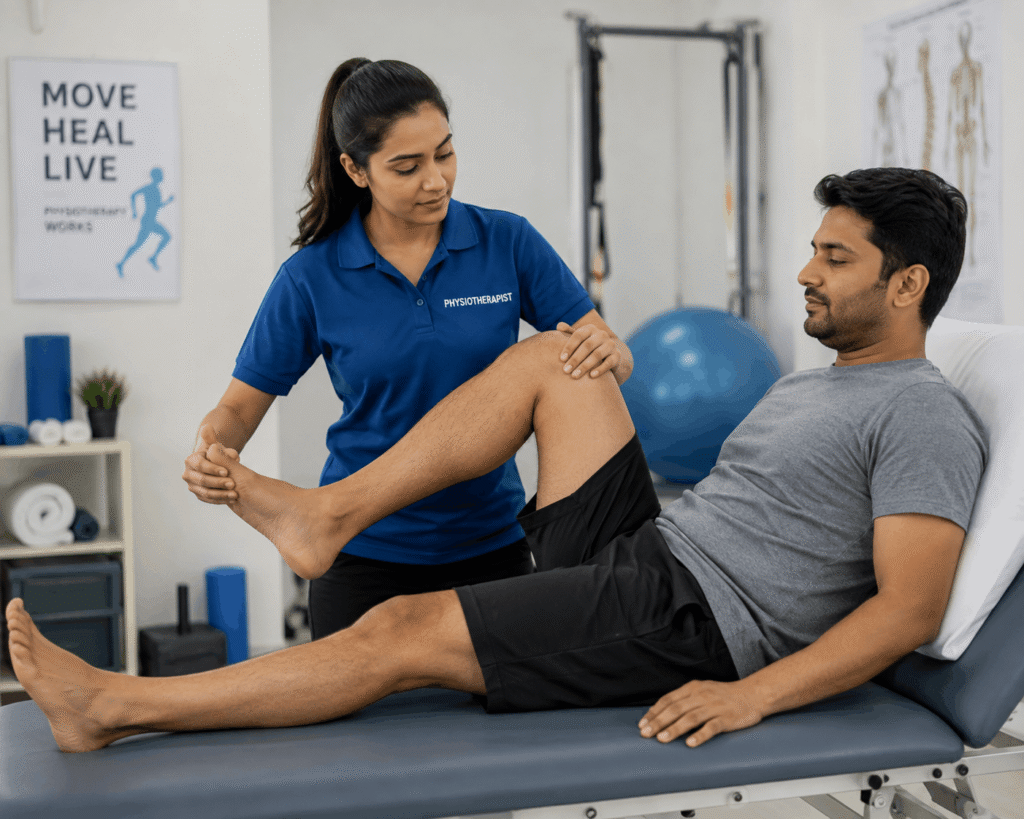
For a practical example of this in action, a sports physiotherapist assessing a knee injury will not just treat the joint. They will usually look at gait, training load and any related muscle weakness, then build a programme that reduces the risk of the same injury happening again.
AHPs, Doctors, Nurses and Other Healthcare Roles: What Is the Difference?
It is easy to lump every clinician together under “healthcare professional”, but the categories matter for anyone trying to understand their own care.
- Doctors (GPs and consultants) complete a medical degree and specialise in diagnosing and managing disease, often prescribing medication or referring on for surgery.
- Nurses are regulated separately by the Nursing and Midwifery Council and focus on a broad range of clinical and personal care.
- Pharmacists are regulated by the General Pharmaceutical Council and specialise in medicines.
- Allied Health Professionals sit alongside these roles as autonomous specialists in a specific area of function, movement, communication or diagnostics.
It is also worth clearing up a common point of confusion. Not every regulated health professional a patient meets carries the official AHP title. Whether audiology counts actually depends on where you look. NHS England’s official list of fourteen professions does not include audiology. UK bodies such as the British Academy of Audiology also generally treat “allied health professional” and “healthcare scientist” as two separate, related categories, since audiology sits within the NHS Healthcare Science workforce family rather than the AHP one.
In other health systems, including parts of Australia, audiology is formally classified as an allied health profession. Closer to home, many UK audiologists, particularly those working privately, are registered with the HCPC, the same statutory regulator that oversees thirteen of the fourteen official AHP professions, even where their specific title sits outside NHS England’s formal AHP list.
The same broad picture applies to sleep physiologists, who investigate conditions such as sleep apnoea. These practitioners work closely alongside AHPs as part of a wider multidisciplinary team, whatever label technically applies to their title.

Where Will You Find an Allied Health Professional?
AHPs work across a much wider range of settings than most people expect, including:
- Hospitals, both inpatient wards and outpatient clinics,
- General Practitioner (GP) surgeries and primary care teams,
- Community health centres and home visits,
- Schools and early years settings,
- Care homes and residential settings,
- Sports clubs and performance environments and
- Private clinics and independent practice.
That last setting is where many patients now choose to access AHP care, particularly for physiotherapy, when NHS waiting lists stretch out for months.
Accessing Allied Health Professional Care Privately in Northern Ireland
Friends Medical Service works with Pendulum Physiotherapy to offer a private Sports Injury & Physio service from our Lurgan clinic, serving patients across Craigavon, Belfast, Lisburn and the wider catchment area. Appointments are delivered by Declan Judge, a chartered physiotherapist with a background in musculoskeletal practice, sports club care and the Southern Health and Social Care Trust. You can book directly online rather than waiting for a slot to free up on an NHS list.
Physiotherapy is not the only genuine AHP profession available privately at FMS. Our DEXA (Bone Density) scanning service is carried out by a registered radiographer, one of the fourteen designated AHP professions in its own right, even though our radiographers are not currently listed individually on our Consultants page. The scan measures bone mineral density in the spine and hips to assess osteoporosis risk. Results come with a full radiology report. Wider imaging, including musculoskeletal and abdominal ultrasound scanning, is also available at FMS as part of the same diagnostics offering.
Alongside physiotherapy and radiography, FMS also offers two complementary specialist services delivered through trusted partners. Our Audiology service, run in partnership with Blueberry Hearing, covers hearing tests and ear wax removal. Our Sleep Analysis service, delivered with Sleep Medical, provides a home sleep study to investigate sleep apnoea. As explained above, neither audiology nor sleep physiology is one of the fourteen AHP professions, but both sit within the same wider private specialist offering that lets patients avoid long NHS waits for assessment.
| Service | What’s Included | Price |
|---|---|---|
| Physiotherapy assessment and treatment | Personalised physiotherapy plan | From £45 |
| Sports medical report | GP-issued fitness-to-participate report | £100 |
| DEXA bone density scan | Radiographer-led scan plus radiology report | £225 |
| Ear wax removal | Microsuction, both ears cleared | £55 (£35 if no wax found) |
| Private hearing test | Full hearing assessment | From £80 |
| Sleep study, own GP referral | Home sleep apnoea test kit | £210 |
| Sleep study, with FMS GP referral | GP consultation plus home test kit | £280 |
Prices are confirmed at the point of consultation and may vary, so it is worth checking current pricing on the relevant service page before booking.
Private vs NHS Allied Health Professional Care: What Is the Difference?
| NHS Route | Private Route at FMS | |
|---|---|---|
| Referral | Usually needed from a GP or consultant | Often booked directly, with GP oversight available where needed |
| Waiting time | Can run to several months, depending on the profession and area | Appointments typically available within days |
| Appointment choice | Fixed by clinic capacity | Choice of appointment time and, for some services, home-based testing |
| Continuity | May see different clinicians across a course of treatment | Ongoing care with the same physiotherapist or audiology team |
| Cost | Free at the point of use | Fee payable, confirmed before booking |
Neither route is automatically “better” for every patient. The NHS remains the right choice for many long-term or complex conditions, particularly where ongoing specialist drug treatment is involved. Private AHP-style care through FMS is best suited to patients who want faster access, a specific appointment time or a home-testing option and who can pay for that convenience.
Why Choose Private Allied Health Support?
- Faster access: a musculoskeletal injury or hearing problem often needs prompt attention to stop it becoming a bigger issue
- Appointment flexibility: book around work, sport or family commitments rather than a fixed NHS slot
- Continuity of care: build an ongoing relationship with the same physiotherapist or audiology team
- Combined services: a physiotherapy assessment can sit alongside a sports medical report, a GP review or wider health checks in a single, joined-up visit
How Allied Health Professional Care Fits Into Your Wider Treatment at FMS
Private AHP-style care rarely happens in isolation. A patient managing a long-standing joint condition, for example, may move between our Rheumatology service for diagnosis and our Sports Injury & Physio service for ongoing rehabilitation, with a GP Appointment available whenever wider medical input is needed or a referral is required for a DEXA scan. Our blog post on osteoarthritis explains this kind of joined-up approach in more detail. Our guide to bone health covers how a radiographer-led DEXA scan fits into monitoring your bone density over time. Our guide to sports injury physiotherapy covers what to expect from a first physiotherapy appointment.
The same applies to our other specialist services. If you would like to understand more before booking, our blog posts on ear wax removal and private sleep analysis set out exactly how each service works, from what happens at the appointment to how quickly you will receive results.
Patients travelling from the Republic of Ireland are also welcome across our services. Full details are available on our Cross-Border Ireland Patients page. To see the full team behind these services, including our physiotherapist and GPs, visit our Consultants page.
Frequently Asked Questions
Do I need a GP referral to see an Allied Health Professional?
It depends on the profession and the setting. On the NHS, many AHP services require a GP or consultant referral, particularly for specialist assessments such as rheumatology-led physiotherapy. Privately, services such as our Sports Injury & Physio clinic can usually be booked directly, though a referral is still needed for services such as sleep studies with your own GP and DEXA bone density scans.
Is a physiotherapist a doctor?
No, they are not. A physiotherapist is an Allied Health Professional, not a medical doctor. Physiotherapists complete a specific degree (or equivalent) in physiotherapy and are regulated by the Health and Care Professions Council. They specialise in movement, function and rehabilitation rather than diagnosing and treating disease more broadly.
Are audiologists and sleep physiologists Allied Health Professionals?
It depends on the context. NHS England’s official list of fourteen AHP professions does not include audiology. Organisations such as the British Academy of Audiology generally treat “allied health professional” and “healthcare scientist” as two related but separate categories. In some other health systems, audiology is formally classified as an allied health profession.
In the UK, many audiologists, including our partnered audiology team at Blueberry Hearing, are registered with the Health and Care Professions Council, the same regulator that oversees most of the official AHP professions, alongside membership of bodies such as the British Society of Hearing Aid Audiologists (BSHAA) and the Irish Society of Hearing Aid Audiologists (ISHAA).
Sleep physiology follows a similar pattern. It is a specialist, regulated field that sits outside the fourteen designated AHP titles but works closely alongside them as part of the wider multidisciplinary team.
How do I know if an AHP is properly registered?
You can search the HCPC’s public “Check the Register” tool by surname and profession to confirm that a physiotherapist, paramedic, occupational therapist or any other AHP is currently registered and entitled to practise in the UK.
Are the radiographers at Friends Medical Service Allied Health Professionals?
Yes, they are. Unlike audiology and sleep physiology, radiography is one of the fourteen officially recognised AHP professions. DEXA bone density scans at FMS are carried out by a registered radiographer, even though our radiographers are not currently listed as individual profiles on our Consultants page.
Can I see an Allied Health Professional privately in Northern Ireland?
Yes, you can. Friends Medical Service offers private physiotherapy and radiographer-led DEXA scanning from our Lurgan clinic, alongside audiology and sleep analysis services delivered through our specialist partners. All of these are available without an NHS waiting list. Patients from the wider Craigavon, Belfast and Lisburn area, as well as cross-border patients from the Republic of Ireland, are welcome to book.
What is the difference between an AHP and a healthcare assistant?
An AHP is a registered, degree-qualified professional who can assess, diagnose and treat patients independently within their scope of practice. A healthcare assistant or support worker typically works under the supervision of a registered professional and does not hold an equivalent independent scope of practice.
How much does private physiotherapy cost at Friends Medical Service?
Physiotherapy at FMS starts from £45 per session. A sports medical report, often needed alongside ongoing physiotherapy for athletes, is priced separately at £100. Current pricing is confirmed on our Sports Injury & Physio service page before you book.
Further Reading
If you’d like to read more from independent, patient-focused sources before your consultation, the following are reputable places to start:
- NHS England: About AHPs, for an official overview of the Allied Health Professions workforce
- NHS Health Careers: Allied Health Professionals, covering each of the fourteen professions in more depth
- Health and Care Professions Council: Check the Register, to confirm a practitioner’s registration status
- Chartered Society of Physiotherapy: What Is Physiotherapy?, for a closer look at one of the most common AHP professions
These sources are useful background reading, but they are not a substitute for a proper clinical assessment of your own symptoms.
Get Started with Private AHP-Led Care at FMS
Understanding what an Allied Health Professional actually is makes it easier to know exactly who you need to see and how quickly you can see them. Whether that is a physiotherapist for a nagging sports injury, an audiologist for a hearing test or a home sleep study to get to the bottom of poor sleep, Friends Medical Service offers a private route into specialist care without the long NHS wait.
To book an appointment, visit our Sports Injury & Physio, Audiology (Hearing Tests and Earwax Removal) and Sleep Analysis service pages, or contact our team directly to discuss which service is the right fit for you.