
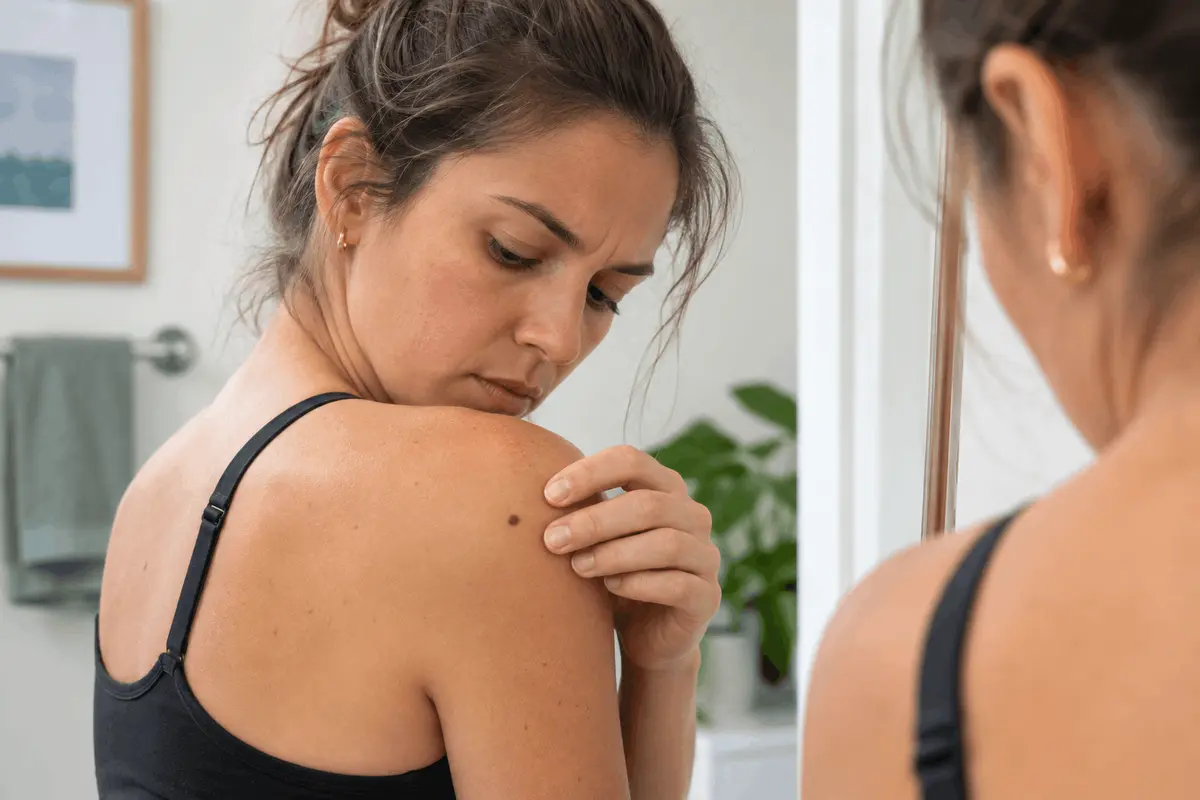
A mole that looks different from how it looked a few months ago deserves a proper examination, and the sooner a clinician looks at it, the easier every next step becomes. Most people who ask when to worry about a mole changing in colour, size and/or shape are worrying about a harmless one. Most changing moles turn out to be benign. A small number are an early sign of melanoma, the most serious type of skin cancer, and change is the clearest signal that separates the two. This guide explains what a changing mole looks like, which changes are reassuring, which are not and how a private
mole check at Friends Medical Service (FMS) in Lurgan works. If you want a wider overview of moles and screening first, our complete guide to moles covers the basics. This article focuses on one question: your mole has changed, so what happens next?Why Moles Change Over Time
A mole (or naevus) is a cluster of pigment-producing cells called melanocytes. Those cells respond to hormones, sunlight and age, so no mole stays frozen for life. Knowing which changes belong to normal skin biology makes it easier to spot the ones that do not.
Changes That Are Part of Normal Life
- New moles appearing through childhood, the teenage years and into your thirties
- Moles darkening slightly during pregnancy
- Moles fading, flattening or disappearing as you get older
- Many moles changing in the same way at the same time, such as several darkening after a summer outdoors
Changes That Deserve a Clinician's Attention
- One mole changing while the moles around it stay the same
- A mole that changes in size, shape or colour over weeks or months
- A mole that becomes raised, lumpy, crusty or sore
- A new dark mole in adulthood that looks unlike your others
Pattern matters more than any single change. Slow change shared across many moles is skin behaving as skin does. A faster, lopsided change in one mole is the reason mole checks exist. The
National Health Service (NHS) states that normal moles do not change over time, which is why any changing mole is worth a second look.
Moles Changing Colour
Colour is one of the three features that carry the most weight when a clinician assesses a pigmented lesion. A healthy mole is one even shade of brown or tan, while melanomas are frequently a mix of two or more colours. Colour changes to watch for include:
- A mole becoming noticeably darker or black in places
- Pale, white or grey patches appearing inside a darker mole
- Red, pink or blue-grey tones appearing where there were none
- Two or more shades within one mole
- Dark flecks or a smudge of pigment spreading into the skin around the mole
A mole that lightens evenly over many years can be part of ageing. Patchy loss of colour next to darker areas is a different picture and needs examining. Photograph the mole in the same daylight every month so you can compare like with like, because colour is hard to judge from memory.
Moles Changing Size
Growth is the second major warning feature. A changing mole that is getting wider over weeks or months, or a flat mole that is becoming raised, should be checked promptly. Size changes to watch for include:
- A mole growing wider than it was a few months ago
- A flat mole developing a bump or raised area
- A mole becoming thicker, firmer or lumpy
- A mole larger than about 6mm across, roughly the width of a pencil end
Small moles can still be melanomas, so size alone never rules a mole in or out. The direction of travel is what counts. A mole that is getting bigger needs attention whatever its starting size.
Nodular Melanoma: Why a Checklist Can Miss It
The familiar ABCDE checklist (asymmetry, border, colour, diameter and evolving) was built around melanomas that start as flat patches. Nodular melanoma behaves differently. According to a patient leaflet from the European Academy of Dermatology and Venereology, nodular melanoma is symmetrical, well defined and one even colour, which can be black, blue or pink-red. For this reason clinicians describe the EFG criteria for nodular lesions: elevated, firm and growing. In plain terms, a firm, raised bump that keeps growing over weeks needs prompt assessment even if it is smooth, round and a single colour. A changing mole does not have to look irregular to be taken seriously.
Moles Changing Shape and Border
Shape changes are the third major feature. A normal mole has a smooth, even outline and two matching halves. Watch for:
- An outline that becomes ragged, notched or blurred
- One half of the mole no longer matching the other
- Colour that bleeds beyond the edge into surrounding skin
- A surface that changes from smooth to rough, scaly or crusted
Other Changes That Count
Not every warning sign is about appearance, and the signs of skin cancer inside a mole are not always visible from a distance. Book a mole check if a mole:
- Itches, tingles or feels tender (an itchy mole is not always cancer, but it is a reason to be seen)
- Bleeds or oozes without being knocked or scratched
- Crusts, scabs or forms a sore that does not heal
- Looks swollen or inflamed
- Looks different from all your other moles (the "ugly duckling" sign)
Cancer Research UK points out that most melanomas cause no pain or itching, and that some harmless moles do itch. A painless mole can still be a concern and an itchy mole is not automatically one, so symptoms alone cannot settle the question. Only an examination can.
Harmless Change or Change to Get Checked?
| What you notice | More reassuring | Book a check |
|---|---|---|
| Colour | Whole mole slightly darker after sun or during pregnancy, like your other moles | Several shades in one mole; patchy dark or pale areas; new red or blue-grey tones |
| Size | No change over years | Growing over weeks or months; flat mole becoming raised |
| Shape | Smooth round or oval outline that stays the same | Ragged or blurred outline; one half different from the other |
| Surface | Smooth and unchanged | Crusting, bleeding or oozing without an injury; a sore that does not heal |
| Sensation | No symptoms | New itching, tingling or tenderness |
| Compared with others | Matches its neighbours | Stands out as different |
The "more reassuring" column is a prompt for continued monitoring, not a clearance. Only a clinician can confirm that a changing mole is harmless.
How a Clinician Assesses a Changing Mole
A proper assessment starts with a conversation about when the change began, what changed, whether the mole itches or bleeds and your family and sun-exposure history. The clinician then examines the mole, any other suspicious skin lesion and the rest of your skin, using a dermatoscope (a hand-held magnifier with a built-in light) where helpful. If you have been asking yourself "is my mole cancerous?", this is the step that gives you a real answer rather than a guess. The National Institute for Health and Care Excellence (NICE)
guidance on suspected cancer recognition and referral (NG12) uses a weighted seven-point checklist for pigmented lesions. Three major features score two points each: a change in size, an irregular shape and an irregular colour. Four minor features score one point each: a diameter of 7mm or more, inflammation, oozing and a change in sensation. A score of 3 or more prompts an urgent suspected cancer referral. Notice that the three heaviest features are exactly the changes this article describes, which is why a changing mole is taken so seriously. After the assessment, one of four outcomes follows:- Reassurance, with advice on what to monitor and when to return
- Findings recorded so a future appointment can compare against today
- Removal of the mole, with the tissue sent for histology (examination under a microscope by a pathologist), which is the reliable way to know exactly what a mole is
- Onward referral to a specialist where that is the right pathway
When to Get a Mole Checked: How Quickly Should You Act?
A changing mole is not a 999 emergency, but it should not be left to see whether it settles. When to get a mole checked has a simple answer: as soon as you notice a change. The NHS advice is to see a GP if you notice any change to a mole. As a practical guide:
- Within days: a mole that is bleeding without injury, growing quickly or becoming a firm raised bump
- Within a few weeks: a slower change in colour, size or shape, or a mole that has started to itch
- Not months: waiting to see "if it gets worse" gives a possible melanoma time to deepen
If you have previously been treated for melanoma, contact your specialist skin cancer team directly with any new change.
What to Do Before Your Appointment
A little preparation makes the appointment more useful.
- Photograph the mole in daylight beside a ruler or coin and note the date
- Write down when you first noticed the change and what changed
- Check the rest of your skin, including hard-to-see areas such as the scalp, soles of the feet and under the nails
- Note any family history of melanoma, previous skin cancer, sunburn history or sunbed use
- Leave the mole alone: do not pick, scratch, shave over it or try home removal kits and creams
Home removal destroys the tissue and leaves nothing for histology, which removes the information a clinician needs most.
Who Is More Likely to Develop Melanoma?
Anyone can develop melanoma, but certain factors raise the risk:
- Pale skin that burns easily
- Red or fair hair
- A large number of moles or freckles
- A close family member who has had melanoma
- A previous skin cancer
- Past sunburn or sunbed use
- Years of outdoor work or intense holiday sun
Darker skin carries a lower risk but not zero risk. Melanoma can also develop on the palms, soles and under the nails, where sun exposure is limited. The Public Health Agency's
Care in the Sun programme has Northern Ireland guidance on protecting your skin.How Friends Medical Service Can Help
Our Lurgan clinic is the base for every skin service we offer, serving patients from Craigavon, Portadown, Belfast, Lisburn, Banbridge, Armagh and beyond.
Private Mole Check
Our private mole check is either a full body mole check or an assessment of a single mole of concern. A clinician looks at the size, shape, colour, border and texture of each mole, uses a dermatoscope where helpful and tells you clearly what was found and what happens next. A full-body check takes around 20 to 30 minutes and no GP referral is needed. Prices are confirmed when you book.Mole Removal With Histology
Where a changing mole needs to come off, our
mole removal service is carried out under local anaesthetic, using excision or shave excision depending on the mole, with tissue sent for histology where clinically indicated. Most patients go home the same day, and facial mole removal is approached with particular attention to the cosmetic result. Minor operations at our clinic include those performed by Mr Abid Rashid, Consultant Plastic Surgeon, and you can meet the rest of the team on our consultants page. Assessment always comes before any decision to remove. If a lesion looks suspicious, the priority is the right specialist pathway, because we are not a dermatology or skin cancer treatment centre. Not every lump on the skin is a mole. If your assessment points to something else, we also offer skin tag removal and lipoma removal as part of our wider minor surgical procedures. Our minor surgery patient guide and our guide to skin tags explain the differences, and our scar revision post covers how healing and scarring are managed afterwards.A Private GP Appointment as a First Opinion
If you would like a doctor to look at a changing mole before deciding on a next step, a
private GP appointment is another route in, including a same-day private GP appointment when you cannot wait. Our sister site, Friends Medical GP, also covers skin concerns in its private GP service, where a GP can examine a mole, advise and refer, and you can read more about what to expect from a private GP versus an NHS GP. A changing mole needs examining in good light with the right equipment, so an in-person visit is better than a video call. For patients who want continuity, our GP subscription plans offer ongoing access to a GP.What We Do Not Provide
We offer mole checks and mole removal, but we do not offer mole mapping (a photographic record of every mole for long-term comparison). Your clinician can advise during your appointment on whether to pursue mapping elsewhere.
Where to Find Us
If you are searching for a mole check near me in Craigavon, Portadown, Lisburn or Belfast, our mole checks and mole removal take place at our Lurgan clinic on the High Street. Our Limavady and L/Derry clinics offer no-scalpel vasectomy appointments only. We welcome
cross-border patients from the Republic of Ireland at all three locations. You can also see how our GP team covers the area through our Lurgan private GP page.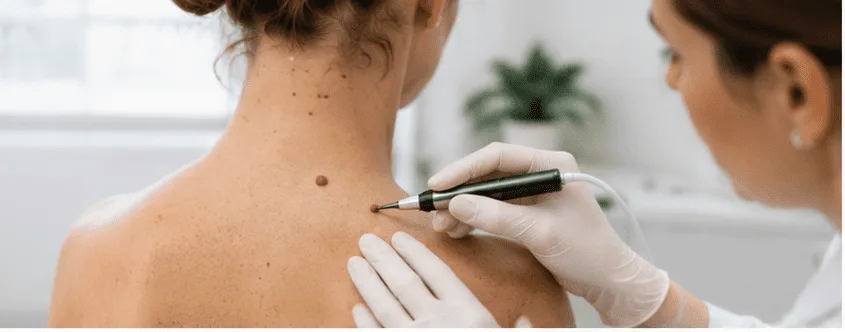
Frequently Asked Questions
Is it normal for a mole to change colour?
Some colour change is normal, for example a slight darkening during pregnancy or after sun exposure, particularly when your other moles change in the same way. A single mole that darkens, develops several shades or shows patchy pale and dark areas is different and should be examined by a clinician.
How much can a mole grow before I should worry?
There is no safe amount of growth to wait out. Size is a prompt, with 6mm often quoted as a guide, but small moles can be melanomas and large moles can be harmless. Any mole that is getting bigger over weeks or months, or a flat mole becoming raised, should be checked.
Can a mole change shape and still be harmless?
Yes. Many benign moles become slightly raised or lose pigment with age. What matters is whether the change is slow and shared across your moles or fast and limited to one mole. A clinician can tell the difference using a dermatoscope and a proper history.
Is my mole cancerous if it has changed?
Not necessarily. Most changing moles are not cancer, and reassurance is the most common result of a mole check. The reason to get checked is that the small number that are melanoma are far easier to treat when found early, and only an examination (and histology where needed) can say which group your mole belongs to.
Should I have a changing mole removed?
Not before it has been assessed. A clinician should examine the mole first and decide whether removal is appropriate. When removal goes ahead, sending the tissue for histology gives you a confirmed answer rather than an assumption.
When should I get a mole checked after noticing a change?
Do not wait. Book a mole check promptly if the mole is bleeding, growing quickly or becoming a firm bump, and within a few weeks for slower changes. Waiting months to see what happens is the one approach to avoid.
Do I need a GP referral for a mole check at Friends Medical Service?
No. You can book a private mole check or a mole removal consultation directly with us without going through your GP first.
Does Friends Medical Service offer mole mapping?
No. We offer mole checks and mole removal at our Lurgan clinic. Mole mapping is not a service we provide, but your clinician can advise whether it would be worth pursuing elsewhere.
Is a mole check painful?
No. A mole check is a non-invasive examination. Nothing is removed on the day unless you have agreed to it and it is clinically appropriate.
Further Reading
If you'd like to read more from independent, patient-focused sources before your consultation, the following are reputable places to start:
- NHS: Symptoms of melanoma skin cancer - the changes in size, shape and colour that may signal melanoma
- nidirect: Moles - Northern Ireland government guidance on moles and when to see your GP
- Cancer Research UK: Symptoms of melanoma - how to check your skin and moles with the ABCDE guide
- NICE: Suspected cancer, recognition and referral (NG12) - the referral guidance clinicians use, including the seven-point checklist
- European Academy of Dermatology and Venereology: Clinical presentation of melanoma - a patient leaflet covering nodular melanoma and the EFG criteria
- Care in the Sun - the Public Health Agency's skin cancer prevention programme for Northern Ireland
These sources are useful background reading and complement, rather than replace, a proper clinical assessment of your own skin.
Final Thoughts
A mole that has changed colour, size or shape is a reason to act, not a reason to worry in advance. Most checks end in reassurance, and the few that do not are the ones where speed matters most. If a mole has changed,
book a private mole check at our Lurgan clinic, explore mole removal if you have already been advised to have a mole taken off, or book a private GP appointment for a first opinion. If you have questions before booking, contact our team and we will point you to the right appointment.