
Respiratory Consultations and Lung Function Tests: Your Complete Guide
If you’ve been struggling with a persistent cough, breathlessness, wheezing, or an asthma diagnosis that never quite feels under control, a respiratory consultant and a proper lung function test can make all the difference. Getting fast, accurate answers about how well your lungs are working is often the first step toward effective treatment and increasingly, patients are choosing a private respiratory consultant to skip lengthy waiting lists and get seen quickly.
This guide walks through what a respiratory consultation involves, what to expect from spirometry testing and FENO testing, how long these appointments take and what they cost so you can approach your appointment feeling informed and prepared. For more health guidance like this, take a look at our blog, or visit our homepage to explore the full range of private medical services on offer.
What Does a Respiratory Consultant Do?
A respiratory consultant is a doctor who specialises in the diagnosis and management of conditions affecting the lungs and airways. This includes asthma, chronic obstructive pulmonary disease (COPD), chronic cough, breathlessness, sleep-disordered breathing and other pulmonary conditions.
During a consultation, your respiratory consultant will typically:
- Take a detailed history of your symptoms, lifestyle and any family history of lung disease
- Carry out a physical examination, including listening to your chest
- Recommend appropriate diagnostic tests, such as a pulmonary function test or FENO test
- Discuss your results in plain language and explain what they mean
- Develop a personalised treatment or management plan
Many people search for a “respiratory consultant near me” because seeing a specialist privately usually means a same-week or next-week appointment, rather than a lengthy referral process. If you’re based in Northern Ireland and looking for a private respiratory consultant near you, you can view our Respiratory Consultant Service or meet our specialist team on the Consultant page.
If ongoing GP access has been a challenge, our GP Subscriptions service is also worth exploring, giving you more consistent access to a doctor alongside any specialist respiratory care you need. Following your consultation, you may also require documentation such as an other medical report for work, insurance, or personal purposes.
What Is a Lung Function Test?
A lung function test, also called a pulmonary function test or pulmonary breathing test, measures how well your lungs work. These tests assess how much air you can breathe in and out, how quickly you can exhale and how efficiently oxygen moves from your lungs into your bloodstream.
Pulmonary function testing is used to:
- Diagnose conditions such as asthma, COPD and pulmonary fibrosis
- Monitor how a known lung condition is progressing
- Assess breathlessness of an unknown cause
- Check lung health before surgery
- Evaluate the effectiveness of current treatment
If you want to check lung function because of ongoing symptoms, your GP or respiratory consultant may recommend one of the tests below. Lung function testing is often carried out alongside other diagnostic checks, such as blood testing and health checks or an ECG, to build a fuller picture of your overall health.
Understanding Spirometry Testing
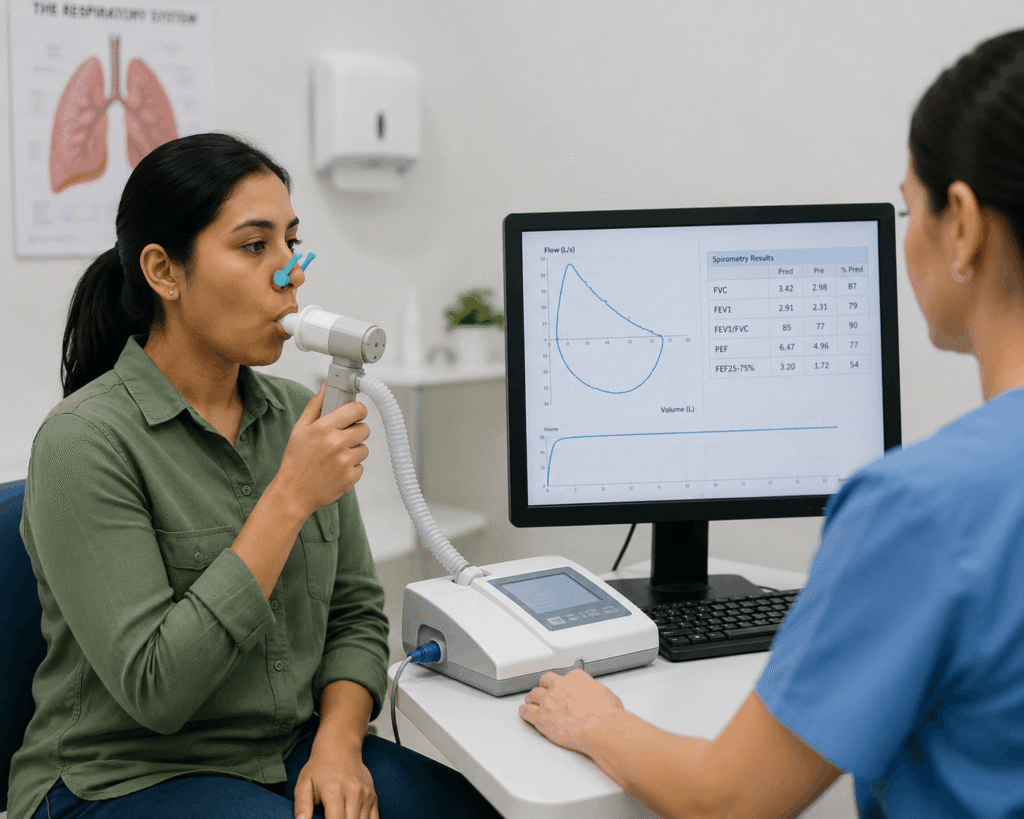
Spirometry testing is the most common type of lung function test. It measures the volume of air you can forcibly exhale after taking the deepest possible breath in, along with how quickly you can do it.
What Is a Spirometry Test?
So, what is a spirometry test, exactly? You’ll be asked to breathe into a mouthpiece connected to a machine called a spirometer. The device records two key measurements:
1. FVC (Forced Vital Capacity)
The total amount of air you can forcibly exhale after a full breath in
2. FEV1 (Forced Expiratory Volume in 1 second)
How much air you can exhale in the first second of that breath
Together, these numbers help identify whether your airways are obstructed (as in asthma or COPD) or restricted (as in some lung tissue conditions).
What to Expect During Spirometry Tests
- You’ll be asked to sit upright with a clip on your nose to prevent air escaping
- You’ll take a deep breath in, then blow out as hard and fast as possible into the mouthpiece
- The test is usually repeated three times to ensure consistent, reliable results
- You may be asked to inhale a bronchodilator (a reliever medication) and repeat the test to see if your airflow improves
Many patients search for a “private spirometry test near me” to get quick, accurate results without a long wait. A private spirometry test is non-invasive, painless and provides results almost immediately. Athletes and active individuals sometimes request spirometry alongside a sports medical report to rule out exercise-induced breathing issues before returning to training.
FENO Testing Explained
FENO testing (Fractional Exhaled Nitric Oxide) is a newer, complementary test that’s become increasingly important in diagnosing and managing asthma.
What Is FENO Testing?
What is FENO testing and what is a FENO test used for? Nitric oxide is naturally produced in the airways and levels rise when there’s inflammation, which is a hallmark of asthma. A FENO breathing test measures the concentration of nitric oxide in your exhaled breath, giving your consultant a direct window into airway inflammation.
Unlike spirometry, which measures airflow, a FENO test for asthma measures inflammation which makes the two tests highly complementary when diagnosing or managing asthma.
How a FENO Asthma Test Works
- You’ll breathe in through a mouthpiece connected to the FENO device
- You’ll then exhale slowly and steadily for around 10 seconds at a controlled rate
- The device displays your result within seconds
- No preparation, needles, or discomfort are involved
Understanding FENO Test Results and Scores
FENO test results are measured in parts per billion (ppb). Generally speaking:
-
Below 25 ppb:
- Normal, low likelihood of eosinophilic airway inflammation,
-
25–50 ppb:
- Intermediate range; clinical correlation needed,
-
Above 50 ppb:
- Elevated, suggestive of eosinophilic inflammation, commonly associated with asthma.
Your respiratory consultant will interpret your FENO test scores alongside your symptoms, spirometry results and medical history, so a single number is never used in isolation. Alongside any medical treatment, small lifestyle adjustments can also help support respiratory health. Our guides on maintaining a healthy lifestyle and boosting your immune system naturally offer some practical starting points.
FENO testing for asthma is particularly useful for:
- Supporting a new asthma diagnosis
- Predicting how well someone will respond to steroid-based inhalers
- Monitoring treatment adherence and effectiveness
- Adjusting medication doses in poorly controlled asthma
How Long Does a Lung Function Test Take?
One of the most common questions patients ask before booking is “how long does a lung function test take?” The good news is that these tests are quick:
-
Spirometry test:
- Typically 15–30 minutes, including instructions, warm-up breaths and repeat attempts
-
FENO test:
- Usually under 5 minutes
-
Full pulmonary function tests (including lung volumes and gas transfer, where required):
- 30–45 minutes
If you’re wondering “how long does a pulmonary function test take?” when combined with a full respiratory consultation, allow around an hour in total to include your history-taking, examination, testing and results discussion. If your results are needed to support a driving medical report, it’s worth mentioning this when you book so your consultant can factor it into your appointment.
Spirometry Test Price and FENO Test Price
Cost is understandably a common consideration. While exact pricing varies by provider, here’s a general overview of what to expect:
-
Spirometry test cost
- This is often bundled with a respiratory consultation, though standalone testing is also available.
-
FENO test price
- This is usually offered as an add-on alongside spirometry for a comprehensive asthma work-up.
For current pricing on a private lung function test or a private spirometry test, it’s best to check directly with your provider, as costs can vary depending on the exact combination of tests required. Visit our Respiratory Consultant Service page for more details on what’s included.
When Is a Pulmonary Function Test Required?
You might be wondering when a pulmonary function test is required. Common triggers for testing include:
- Ongoing or worsening breathlessness,
- A chronic cough lasting more than eight weeks,
- Wheezing or chest tightness,
- A family history of asthma, COPD, or other lung disease,
- Monitoring a known respiratory condition over time,
- Pre-operative assessment before certain types of surgery,
- Occupational exposure to dust, chemicals, or fumes.
If any of these apply to you, booking a consultation with a respiratory consultant is a sensible next step. It’s also worth reading more broadly about the benefits of utilising a private medical centre if you’re considering private care for the first time and our guide on how to prepare for a routine medical check-up offers useful general tips ahead of any appointment.

Why Choose a Private Respiratory Consultant?
Choosing a private respiratory consultant rather than waiting on a standard referral pathway offers several advantages:
- Faster appointments, often within days rather than months,
- Same-visit testing; Spirometry and FENO testing frequently available during your consultation,
- Continuity of care, as you will see the same consultant throughout diagnosis and treatment,
- Comprehensive assessment, with enough time to properly discuss symptoms, lifestyle and concerns,
- Clear, unhurried explanations of your results and next steps.
Searching for private respiratory consultants near you? Patients travelling across the border for care may also find our page on cross-border Ireland patients helpful for understanding how to access private respiratory services.
Related Services and Resources
Respiratory health is often just one part of a broader picture of overall wellbeing. Depending on your circumstances, you might also find the following useful:
- Travel Vaccinations Guide
- Useful if respiratory symptoms or a chronic lung condition affect your travel plans
- Gynaecology Services
- For women’s health needs alongside respiratory care
- Private STI/STD Testing in Northern Ireland
- Confidential sexual health screening
- Private Rheumatology in Northern Ireland
- For joint and autoimmune conditions that can sometimes overlap with respiratory symptoms
- Private DEXA Scan in Northern Ireland
- Bone density scanning, particularly relevant if you’re on long-term steroid treatment for asthma
- Ultrasound and Guided Injection and are ultrasound-guided injections painful?
- For musculoskeletal concerns
- Frustrated with no GP appointments?
- Read more about the benefits of faster, private access to care
- Transforming Healthcare Access in Northern Ireland
- Learn more about how Friends Medical is changing private healthcare locally
Frequently Asked Questions
What is a FENO test used for?
A FENO test measures nitric oxide in your exhaled breath to detect airway inflammation, most commonly to help diagnose and monitor asthma.
What is a spirometry test used for?
A spirometry test measures how much air you can breathe out and how quickly, helping to diagnose and monitor conditions like asthma and COPD.
How long does a lung function test take?
Most individual tests, such as spirometry or FENO, take between 5 and 30 minutes. A full assessment alongside a consultation typically takes around an hour.
Do I need to prepare for a spirometry or FENO test?
You may be asked to avoid smoking, vigorous exercise, or certain inhalers for a few hours beforehand, as these can affect your results. Your consultant will confirm specific instructions when you book.
Are lung function tests painful?
No. Both spirometry and FENO testing are completely non-invasive and involve nothing more than breathing into a mouthpiece.
What do high FENO test scores mean?
Higher FENO scores generally indicate increased airway inflammation, which is often associated with asthma. However, results are always interpreted alongside your symptoms and other test findings.
Can I get a spirometry and FENO test on the same day?
Yes. Many respiratory consultations include both tests together, giving a fuller picture of your lung function and airway inflammation in a single visit.
How do I book a private respiratory consultant near me?
You can book directly through our Respiratory Consultant Service page, where you’ll find details on our specialist consultants and available testing.
Further Reading
If you’d like to read more about respiratory conditions and lung function testing from trusted, independent health organisations, the following resources offer clear, patient-friendly information:
- NHS: Asthma, an overview of asthma symptoms, causes, and treatment options.
- NHS: Chronic Obstructive Pulmonary Disease (COPD), guidance on COPD symptoms, diagnosis, and living with the condition.
- Asthma + Lung UK: Spirometry and Bronchodilator Reversibility Test, a patient guide to what happens during a spirometry test and how results are interpreted.
- Asthma + Lung UK: FeNO Test, an explanation of FeNO testing, what it measures, and how it’s used in asthma care.
Final Thoughts
Whether you’re managing existing asthma, investigating unexplained breathlessness, or simply want to check lung function as part of a wider health review, combining a consultation with a respiratory consultant and the right diagnostic tests (spirometry, FENO, or full pulmonary function testing) gives you a clear, evidence-based picture of your respiratory health. Choosing a private respiratory consultant means faster access, same-visit testing and more time to have your questions properly answered.
To find out more or to book your appointment, visit our Respiratory Consultant Service page or explore our full range of services.