
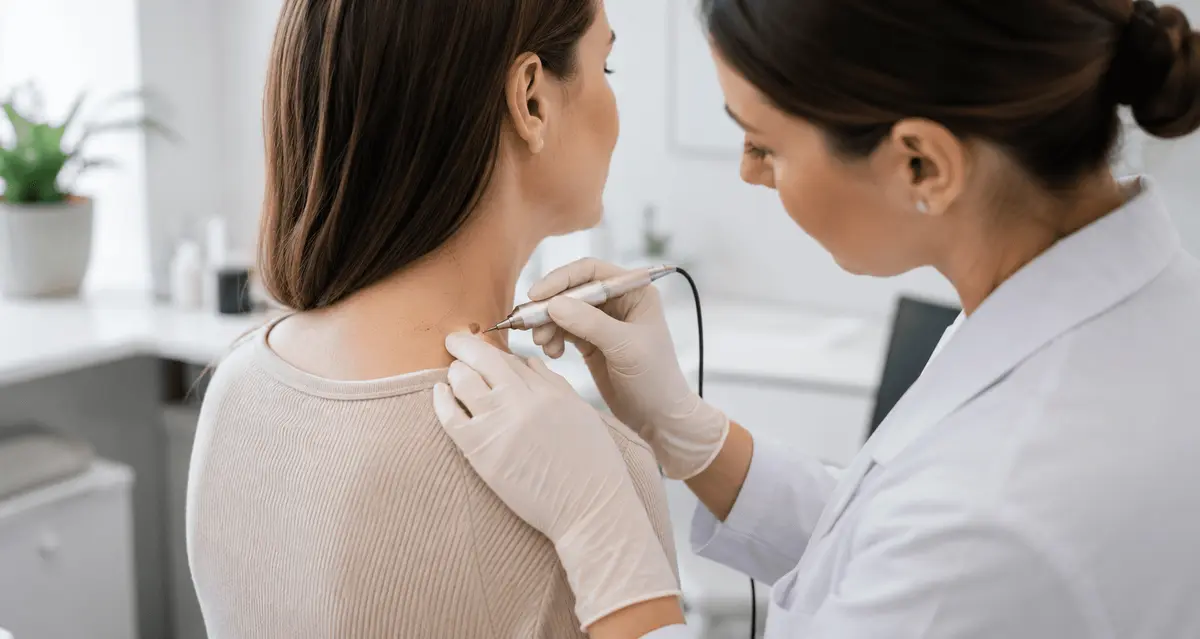
A skin tag that has sat unnoticed for years and then darkens, swells or changes outline is a skin tag asking for attention. Most of these changes have a simple explanation, such as friction, a twisted stalk or a small knock. Some do not, and the only reliable way to tell the difference is to have the growth looked at by a clinician. This guide explains why a skin tag changes colour, size and shape, which changes are harmless, which are warning signs and what to do next if you live in Northern Ireland or travel here from the Republic of Ireland.
What a Normal Skin Tag Looks Like
A skin tag (also called a cutaneous tag, a flesh tag or, medically, an acrochordon) is a soft growth of skin that hangs from a narrow stalk. According to the National Health Service (NHS), skin tags are the same colour as the surrounding skin or a little darker, they range from about 2mm to 5cm across and they rarely hurt. Knowing the baseline helps you spot change. A typical skin tag is:
- Soft and smooth, with a surface that matches the skin around it
- Free to move when you nudge it, because it hangs from a stalk
- Painless unless something rubs or catches it
- Stable in size for months or years at a time
They appear where skin folds or rubs against clothing and jewellery: the neck, armpits, eyelids, groin and under the breasts. Our
Skin Tags Explained guide covers causes and risk factors in full. This post focuses on what happens when a skin tag stops behaving like the baseline above.
Why a Skin Tag Changes Colour
Colour change is the most common reason people search for answers, and the colour you see points to the cause.
A Skin Tag Turning Dark Purple or Black
A skin tag hangs from a thin stalk that carries its blood supply. If the tag twists on that stalk, the blood supply is squeezed off and the tissue darkens to purple, brown or black. It may become tender and swollen while this happens. In many cases the tag then shrivels and falls off, which answers a question many people ask: do skin tags fall off? They can, but only when the blood supply is lost, and the process is unpredictable and uncomfortable. A dark tag deserves a clinical look for two reasons. First, a twisted tag can be sore and may bleed. Second, a dark or black growth is also a feature of some moles and skin cancers, so you should not assume that darkening means a harmless twist.
A Skin Tag That Is Red, Sore or Inflamed
A red skin tag is irritated in most cases. Collars, necklaces, bra straps, razors and waistbands all catch tags on the neck, armpits and groin. Repeated rubbing causes redness and soreness, and a tag that has bled or been scratched can become infected. Signs of an infected skin tag include:
- Spreading redness around the base
- Warmth and swelling
- Pus or weeping
- Increasing pain
- Fever or feeling unwell
An infected skin tag needs medical assessment. A
private GP appointment at our Lurgan clinic can look at the area, decide whether treatment is needed and advise on removal once the skin settles.Brown Patches and Uneven Pigment
Some people notice a skin tag looking darker than before, or a darker patch around it. Friction and sun exposure both stimulate pigment, and skin folds hold moisture and rub constantly. Skin tags on darker skin tones also tend to sit a shade deeper than the surrounding skin. A slow, even darkening across the whole tag is less worrying than a patchy or multi-coloured change, but patchy colour is exactly the pattern that deserves a check.
Bruising
A tag knocked or caught on clothing can bruise. The colour fades over days like any bruise. A tag that stays dark beyond two to three weeks, or a bruise with no memory of a knock, should be looked at.
Why a Skin Tag Gets Bigger
Skin tags can grow over time. A large skin tag or a big skin tag on the neck or underarm is a common complaint, and the reasons are well understood:
- Ongoing friction from folds, collars and jewellery keeps stimulating the skin
- Weight gain, which deepens skin folds and increases rubbing
- Pregnancy, because hormonal changes are linked to new and larger tags
- Type 2 diabetes and insulin resistance, which the NHS links to more skin tags
- Age, since tags become more common from middle age onwards
- Swelling from irritation, which makes a tag look bigger for a few days
The NHS advises seeing a GP (general practitioner) if a skin tag gets bigger, becomes painful, starts bleeding or develops into lots of skin tags. A tag that grows steadily, rather than swelling briefly after irritation, is the one to have examined.
Why a Skin Tag Changes Shape
Shape change is subtler than colour or size and easier to miss. Common harmless causes include:
- Twisting, which flattens or elongates the tag and can precede a colour change
- Rubbing, which smooths or roughens the surface
- Scabbing, where a nick from shaving leaves a crust that alters the outline
- Stretching, where a heavier tag pulls its own stalk longer
Be more cautious if the outline becomes irregular, if the surface turns scaly or ulcerated or if the growth no longer hangs from a stalk but sits flat on the skin. These features do not fit a skin tag.
Skin Tag or Something Else? Lesions That Look Alike
A growth that changes is not proven to be a skin tag in the first place. Warts, moles and other skin lesions can be mistaken for a tag, which is why people search for "warts and skin tag" differences. The table below shows how common look-alikes behave.
| Lesion | Normal appearance | What a worrying change looks like |
|---|---|---|
| Skin tag | Soft, skin-coloured, hangs on a stalk | Bleeding without a knock, rapid growth, multiple colours, flat base |
| Wart | Firm, rough, raised surface | Spreading or clustering, bleeding, pain |
| Mole | Flat or slightly raised, round or oval, one colour | Change in size, shape or colour, itching, crusting, bleeding |
| Seborrhoeic keratosis | Waxy, brown, "stuck on" surface | Sudden crops of new lesions or a rapidly changing lesion |
| Basal cell carcinoma | Pearly bump or sore that scabs and does not heal | Bleeding, ulceration, non-healing |
| Melanoma | New or changing dark mole, uneven edges | Colour change, growth, asymmetry, evolving shape |
The NHS describes a mole that changes size, shape or colour as a possible sign of melanoma. Our
Skin Cancer Awareness guide explains the ABCDE checklist (Asymmetry, Border, Colour, Diameter and Evolving) and the signs of skin cancer that need prompt review. Our guide to moles covers screening and when removal is appropriate. We are not a dermatology or skin cancer treatment centre. Where a lesion looks suspicious, the priority is a fast route into the right specialist pathway.Warning Signs: When to See a Doctor
Arrange an appointment promptly if a skin tag or skin lesion shows any of the following:
- A change in colour that is patchy, multi-toned or turns black without an obvious twist
- Rapid growth over weeks rather than years
- Bleeding without being caught on clothing
- Crusting, ulceration or a sore that does not heal within four weeks
- Itching or pain that has no clear cause
- An irregular outline or a flat base instead of a stalk
- Many new tags appearing quickly
- Redness, swelling or pus suggesting infection
Skin cancer is the most common cancer in Northern Ireland, and finding it early makes it easier to treat. If you are wondering when to get a mole checked or when to worry about a mole, the answer is the same: change is the signal, so act on it. If a GP suspects melanoma, the NHS says a hospital specialist appointment follows within 2 weeks.

What Not to Do at Home
Tying a thread around the base, cutting the tag with scissors, applying nail varnish or using over-the-counter freezing kits are all tempting. The NHS advises against removing a skin tag yourself unless a GP recommends it, because of the risk of infection, bleeding and scarring. There is a second problem: a tag removed at home is never examined, so a changing lesion that was not a tag at all goes unchecked. When tissue is sent for analysis (histology), you get a definite answer instead of an assumption.
What Happens at an Appointment
A clinician will look at the growth in good light, ask how long it has been there, ask what has changed and check your other skin. A dermatoscope, a handheld magnifier with built-in light, may be used. The outcomes fall into three groups:
- A harmless skin tag, with reassurance and the option to leave it or have it removed
- An irritated or infected skin tag, with treatment for the skin and removal later if wanted
- A lesion that is not a skin tag, with removal and histology or referral to a specialist
Skin Tag Removal at Friends Medical Service
Skin tag removal is a personal choice rather than a medical need, and it is considered cosmetic, so it is not offered on the NHS. Our
skin tag removal service is a short minor surgical procedure carried out under local anaesthetic at our Lurgan clinic. Minor operations at Lurgan are carried out by Mr Abid Rashid, Consultant Plastic Surgeon, and you can meet the wider team on our consultants page. What to expect:- Consultation: the clinician examines each tag and confirms what it is
- Price: the cost depends on the number and location of tags and is confirmed before anything goes ahead
- Procedure: the area is numbed and each tag takes only a few minutes
- Histology: tissue is sent for analysis if there is any clinical reason to check it
- Aftercare: a small dressing, simple advice and a return to normal activity the same day
The NHS notes that removal can leave scarring or darker skin where the tag was, particularly on black or brown skin, and that this is temporary in most cases but can sometimes be permanent. If you are worried about marking from an earlier procedure, read our
scar revision guide. Minor surgical procedures take place at Lurgan only. Our Limavady and L/Derry clinics offer No-Scalpel Vasectomy appointments and nothing else. For more on the full range, see our minor surgical procedures overview or the minor surgical procedures service page. If the growth is soft and doughy rather than hanging from a stalk, it may be a lipoma, which has its own guide and removal service. A suspicious mole can be assessed through our mole removal service.Many New Skin Tags All at Once
Many people ask why they are getting skin tags all of a sudden. A burst of new tags can reflect pregnancy, weight change or friction from a new habit, but the NHS also links skin tags with type 2 diabetes because insulin resistance appears to drive their growth. If you have developed lots of tags without an obvious reason, a blood test is a sensible next step. Our
blood testing and health checks can screen for diabetes risk, and our diabetes management guide explains what the results mean. If excess weight and skin folds are part of the picture, our weight management service offers structured support.How Friends Medical Service Can Help
Different situations suit different starting points:
- A red, sore or possibly infected tag: book a same-day private GP appointment, with 15-minute appointments from £70 at our Lurgan clinic
- A skin problem you want a GP to look at first: see our private GP skin appointments
- A simple query you can describe with a photo: an online GP appointment is available, though anything changing, bleeding or painful is better seen in person
- Appointment options and lengths: compare 15, 30 and 45-minute private GP appointments
- Regular access to a GP: our GP membership spreads the cost of repeat visits
- A GP who knows the area: meet Dr Abdel Nasir Nour and the clinical team
- Travelling in from further afield: our Lurgan clinic serves Craigavon, Belfast, Lisburn and the wider area, and you can find directions on the Lurgan page
- Patients from the Republic of Ireland: see our cross-border patient information, as all three clinic locations welcome cross-border patients

Frequently Asked Questions
Why is my skin tag turning black?
A skin tag turns black or dark purple when its stalk twists and cuts off the blood supply. The tag may then shrink and fall off. Because dark colour is also a feature of some moles and skin cancers, have a darkened growth examined instead of assuming it is a twisted tag, particularly if it did not hurt or you cannot see a stalk.
Why is my skin tag red and sore?
Redness and soreness come from friction in most cases with clothing, jewellery or a razor. A tag that has bled or been scratched can become infected, with spreading redness, warmth, swelling or pus. Book an appointment if symptoms last more than a few days or the skin around the tag looks inflamed.
Can a skin tag change shape?
Yes. Twisting, rubbing and stretching can flatten, lengthen or roughen a tag. An irregular outline, a scaly or ulcerated surface or a flat base with no stalk are different. These features do not fit a skin tag and need a clinical review.
Why is my skin tag getting bigger?
Growth is linked to continued friction, weight gain, pregnancy, type 2 diabetes and age. A tag can also swell briefly after irritation. The NHS advises seeing a GP if a skin tag gets bigger, becomes painful or starts bleeding, so a steadily growing tag should be checked.
Can skin tags be cancerous?
A true skin tag is benign and does not turn into skin cancer. The difficulty is that moles, warts and early skin cancers can look similar. A growth that changes colour, grows quickly or bleeds without being caught should be examined before anyone calls it a skin tag.
Do skin tags go away on their own?
Rarely. A tag may fall off if it twists and loses its blood supply, but this is unpredictable and can be painful. Most tags stay until they are removed.
Is it safe to remove a skin tag at home?
No. The NHS advises against removing a skin tag yourself unless a GP recommends it, citing infection, bleeding and scarring. Home removal also means the tissue is never examined, so a lesion that was not a skin tag goes unnoticed.
Do I need a referral for skin tag removal or a mole check?
No. You can book skin tag removal or a mole check with us directly. Pricing for removal depends on how many tags there are and where they sit, and it is confirmed at your consultation.
Where can I get a skin tag removed near me in Northern Ireland?
Our Lurgan clinic offers skin tag removal and serves patients from Craigavon, Portadown, Belfast, Lisburn, Banbridge, Armagh and beyond. Our Limavady and L/Derry clinics provide No-Scalpel Vasectomy only, so removal takes place in Lurgan.
Further Reading
If you'd like to read more from independent, patient-focused sources before your consultation, the following are reputable places to start:
- NHS: Skin tags, covering appearance, causes, when to see a GP and removal
- NHS: Moles, explaining which mole changes need a GP review
- nidirect: Skin tags, Northern Ireland's official public information service
- Cancer Research UK: Skin cancer, with symptoms and diagnosis information
- British Association of Dermatologists: Patient information leaflets, written by dermatologists
- Care in the Sun, the Public Health Agency's skin cancer prevention programme for Northern Ireland
These sources supplement but do not replace a clinical assessment.
Final Thoughts
A skin tag that changes colour, size or shape has a simple explanation in most cases, but that is not a reason to wait when the change is rapid, patchy, bleeding or painful. A short appointment gives you a clear answer and, if you want it, a same-visit plan for removal. If you have a skin tag you want assessed or removed, visit our
Skin Tag Removal service page to book. If you want a GP to look at it first, book a private GP appointment. For questions before you decide, contact our team and we will point you to the right service.