An itchy or sore skin tag is one of the most common reasons patients book a minor procedure, because a growth that was painless for years suddenly starts to catch, rub or burn. A skin tag is a soft, harmless flap of skin on a narrow stalk; most cause no symptoms at all. When one does, the cause is simple in most cases: friction, twisting or irritation. The same symptoms can also point to a different lesion that needs a proper look.
This guide explains why a tag becomes itchy or sore, what you can do at home, which warning signs need a clinician and how private skin tag removal works at Friends Medical Service (FMS) in Lurgan. If you want the basics first, our Skin Tags Explained guide covers causes and general removal options.
Why Do Skin Tags Become Itchy or Sore?
Most skin tags cause no discomfort, which is why many people barely notice theirs. Symptoms appear when something changes around the skin tag. Five triggers account for the large majority of complaints.
Friction From Clothing and Jewellery
Tags form where skin rubs, so they sit in the exact places where rubbing continues. A collar, necklace chain, bra strap, waistband or watch strap can drag across a skin tag dozens of times a day. This is why a tag on the neck or in the armpit is the one that flares up first. Repeated catching irritates the base of the skin tag and the surrounding skin, which produces a sore, tender or red skin tag. Shaving over a tag causes the same problem in a single stroke.
Twisting on the Stalk
A tag hangs from a narrow stalk that can twist. Doctors call this torsion. A twisted skin tag loses part of its blood supply, becomes swollen and painful; it can turn dark red, purple or black. The pain is sharp and sudden rather than a slow itch. Some tags die off and fall away after twisting; the process is unpredictable and uncomfortable, so the tag is better assessed than left to run its course.
Sweat, Moisture and Skin Folds
Tags in the armpit, groin, under the breast and around the neck sit in warm, damp folds. Trapped sweat softens the skin and makes friction worse, which sets off itching. The skin around a tag in a fold can also develop a rash called intertrigo, which feels hot, raw and itchy even though the tag is not the source.
Irritation From Products and Metals
Soaps, perfumed body wash, deodorant, fabric conditioner and costume jewellery containing nickel can all inflame the skin around a tag. This type of reaction, called contact dermatitis, produces an itchy skin tag with a patch of redness or dry scaling around the base. Patients blame the tag when the real cause is the necklace or the new shower gel.
Infection
A scratched or torn skin tag gives bacteria a way in. An infected skin tag becomes red, warm, swollen and tender; it can also weep or form pus. Infection needs treatment from a clinician rather than waiting for it to settle on its own. The warning signs are covered further down this page.

Itchy Skin Tag vs Sore Skin Tag: What Each Symptom Can Tell You
The pattern of your symptoms points towards the cause behind them. The table below is a guide only; it cannot replace an examination.
| What you notice | What can be behind it | Sensible next step |
|---|---|---|
| Mild itch with no redness | Dry skin, sweat or light friction | Gentle skincare and reduced rubbing |
| Itch with a red or scaly patch around the base | Contact dermatitis or eczema near the tag | Stop the suspected trigger; speak to a pharmacist or GP |
| Tender after catching on clothing | Minor friction injury | Protect the area and keep it clean |
| Sudden sharp pain with dark colour change | Twisting of the stalk | Have it assessed by a clinician |
| Red, warm, swollen skin tag with pus | Infection | Same-day GP appointment |
| Bleeding with no obvious cause or a change in size or colour | A lesion that may not be a tag | Prompt assessment by a clinician |
When an Itchy or Sore Growth Is Not a Skin Tag
A real tag is soft, the same colour as your skin or slightly darker; a narrow stalk attaches it. It is not a form of skin cancer and does not turn into one. The difficulty is that other lesions look similar at a glance, including moles, warts, seborrhoeic keratoses (harmless, waxy, stuck-on growths) and, very rarely, an early skin cancer. An itch or soreness that does not settle is one reason a lesion deserves an examination before anyone assumes it is a tag.
Book an assessment if the growth shows any of these features:
- It is getting bigger over weeks or months.
- It has changed colour or contains more than one shade.
- It bleeds without being caught on clothing or jewellery.
- It has an irregular edge or a crusted, ulcerated surface that does not heal.
- It sits flat against the skin rather than hanging from a stalk.
- It has appeared suddenly as a single new growth after the age of 40.
Our Skin Cancer Awareness guide explains the warning signs in detail. If the growth looks more like a mole than a tag, our mole guide describes what a check involves. The mole check service can examine several lesions in one visit.
A growth in the groin or genital area deserves particular attention. Genital warts can look very similar to tags, so an itchy or sore growth in that region is best reviewed through our sexual health service rather than treated as a tag.
What You Can Do at Home for an Itchy or Sore Skin Tag
Simple steps settle most mild irritation within a few days. They protect the skin; they do not remove the tag.
- Reduce the rubbing. Swap the necklace, loosen the collar, move the bra strap or choose softer fabrics such as cotton.
- Wash gently. Use lukewarm water and a mild, fragrance-free cleanser, then pat the area dry rather than rubbing.
- Keep folds dry. After washing or exercise, dry skin folds thoroughly so sweat does not sit against the tag.
- Use a plain moisturiser. A fragrance-free emollient on the surrounding skin reduces dryness and itching.
- Cover a tag that keeps catching. A small soft dressing acts as a buffer against clothing.
- Avoid scratching. Scratching breaks the skin and invites infection, so keep nails short and use a cool, clean compress when the itch flares.
- Swap potential irritants. Change one product at a time, such as a new deodorant or body wash, to find the trigger.
A pharmacist can advise on gentle skincare products and whether your symptoms need a GP.
What Not to Do
Home remedies for skin tags attract a lot of attention online. Cutting a tag with scissors, tying it off with thread, picking at it or applying apple cider vinegar or tea tree oil carries real risks. Larger tags can bleed heavily when cut or pulled. Acidic or undiluted products burn healthy skin and can leave a scar. Home removal also means nobody confirms what the lesion was in the first place. Over-the-counter freezing kits are not suitable near the eyes or on sensitive skin. Eyelid tags need professional care.
When to See a GP About an Itchy or Sore Skin Tag
The National Health Service (NHS) advises seeing a General Practitioner (GP) if a tag gets bigger, becomes painful, starts bleeding or if you develop lots of them. Arrange a same-day appointment if you notice:
- spreading redness around the tag,
- heat, swelling or pus,
- a temperature or feeling unwell in yourself,
- severe pain, particularly with a dark or black skin tag, or
- bleeding that does not stop with gentle pressure.
Our private GP appointment service offers face-to-face and video consultations. The sister site offers same-day private GP appointments across the Lurgan, Craigavon, Belfast and Lisburn area. For a rash or irritation near a tag, the skin rash page explains what a private GP can assess. If waiting for an NHS slot is the obstacle, our post on frustration with no GP appointments sets out the alternatives.

Do Itchy Skin Tags Point to an Underlying Health Problem?
One irritated tag after a long day in a tight collar says nothing about your general health. A sudden crop of many tags is different. Large numbers are linked with insulin resistance and type 2 diabetes. They are also more common in pregnancy and in people carrying extra weight, because of the added friction in skin folds.
If you have developed several new tags, ask whether a blood sugar check is sensible. Other symptoms such as increased thirst, passing urine more often, tiredness or slow-healing cuts strengthen the case for testing. Our diabetes management guide explains the condition in plain language. A glycated haemoglobin (HbA1c) test reflects average blood sugar over the previous two to three months. It is available through our blood testing and health checks service and does not require fasting.
Where excess weight adds to friction in the folds, the weight management service offers clinician-led support. Weight loss reduces rubbing, though it does not remove tags that have already formed.
Private Skin Tag Removal at Our Lurgan Clinic
No medical rule says a tag must come off. Tags that cause no trouble can stay. Removal makes sense when a tag stays sore, keeps catching, bleeds or affects your confidence. Itching and soreness come from continuing friction, so a tag in the wrong place keeps irritating you however carefully you protect it. Removal ends the problem at its source.
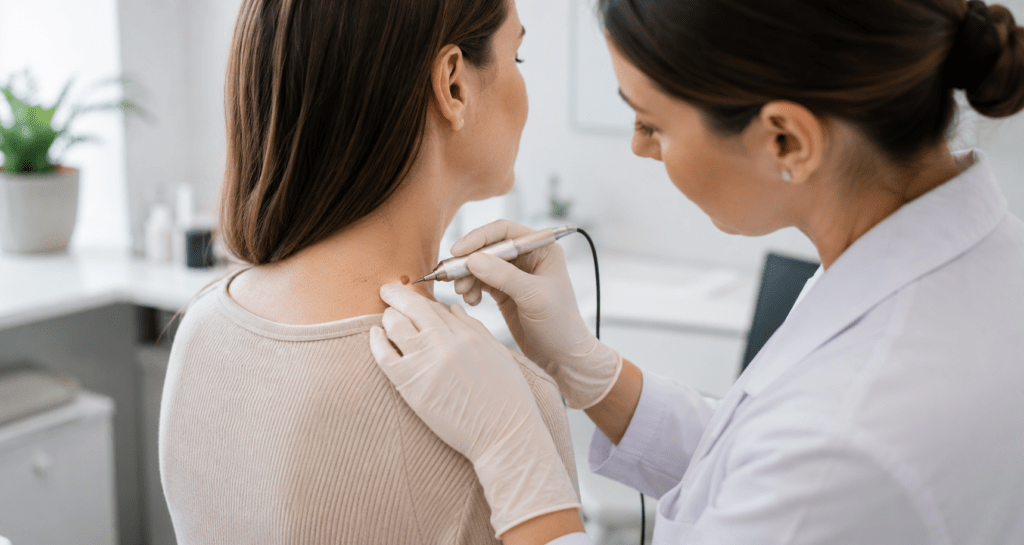
At FMS, private removal takes place at our Lurgan clinic as a short minor surgical appointment. Our Consultant Plastic Surgeon Mr Abid Rashid carries out minor operations at the Lurgan site. Here is what to expect:
- Assessment. A clinician examines the tag, confirms what it is and checks the surrounding skin for infection or dermatitis.
- Planning. You agree how many tags are being removed and where. Several tags can be treated in the same visit.
- Price confirmation. The cost depends on the number and location of the tags, so the price is confirmed at your consultation before anything goes ahead.
- Procedure. Removal takes place under local anaesthetic so the area is numb. A single tag takes only a few minutes.
- Histology. Tissue is sent for testing if there is any clinical reason to check it.
- Aftercare. A small dressing is applied and you go home with simple aftercare advice. Most people return to normal activities the same day.
Our guide to private minor surgery in Northern Ireland covers the wider range of procedures. That includes lipoma removal for soft lumps under the skin that people sometimes mistake for tags.
Leave It, Protect It or Remove It?
| Option | Best for | Limit |
|---|---|---|
| Leave it alone | A tag that causes no symptoms | None needed |
| Home protection and gentle skincare | Mild, occasional itching or soreness | Does not remove the tag |
| Clinic removal | Tags that stay sore, bleed, twist or catch repeatedly | Needs an appointment and a confirmed price |
| Urgent GP review | Redness, heat, pus, fever or a changing lesion | Needs prompt assessment |

How Friends Medical Service Can Help
FMS brings the assessment and the treatment together, so you do not need one provider for a diagnosis and another for removal. If you are unsure what your growth is, a GP can examine it first. Dr Abdel Nasir Nour is one of the clinicians on our GP team. Patients who see a GP regularly can look at the private GP subscription for ongoing access.
Our Lurgan clinic serves patients across Craigavon, Portadown, Belfast, Lisburn, Banbridge and Armagh. Patients from the Republic of Ireland (ROI) are welcome too; our cross-border patients page explains how.
Frequently Asked Questions
Why is my skin tag itchy?
Itching comes from the skin around the tag rather than the tag itself. Friction from clothing, sweat trapped in a fold, dry skin and contact dermatitis from products or jewellery are the main causes. If the itch continues for more than a couple of weeks despite gentle skincare, have the area examined so that dermatitis or a different type of lesion can be ruled out.
Why is my skin tag sore or tender?
Soreness comes from repeated catching on clothing or jewellery, a twist in the stalk or infection. A skin tag that was pulled or scratched can stay tender for several days. Persistent pain, redness spreading outwards or a dark colour change are all reasons to be seen promptly.
Why has my skin tag turned dark or black?
A dark red, purple or black skin tag has lost its blood supply through twisting of the stalk. Some then shrivel and fall off. The change can be painful. A dark growth can also be a different type of lesion, so a clinician should confirm what it is before you assume it is a twisted skin tag.
Can an infected skin tag be dangerous?
Most infections are mild and respond well to treatment. Spreading redness, heat, swelling, pus or a fever mean that a clinician should see you the same day. Infection that spreads into surrounding tissue needs antibiotics, so prompt treatment prevents complications.
Is a bleeding skin tag serious?
A skin tag that bleeds after catching on a zip or necklace and then stops is rarely a concern. Bleeding with no obvious cause, bleeding that repeats or bleeding from a growth that has changed in size or colour needs assessment. Press gently with a clean cloth if it bleeds and book an appointment if it recurs.
Do skin tags fall off on their own?
Symptoms settle once the irritation stops, but the skin tag itself rarely disappears. Occasionally a twisted skin tag loses its blood supply and falls off, though this cannot be predicted. A skin tag that keeps flaring up is best dealt with by removal.
Can I cut or tie off an itchy skin tag at home?
Home removal is not recommended. Cutting or tying a tag risks heavy bleeding, infection and scarring. It also removes the chance of confirming what the growth was. A clinician can remove a tag in a few minutes under local anaesthetic with a sterile technique.
Does skin tag removal hurt?
The area is numbed with local anaesthetic before the procedure starts, so most people feel little more than mild pressure. Mild tenderness afterwards fades within a few days.
How much does private skin tag removal cost in Northern Ireland?
The price depends on how many tags are being removed and where they are on the body. We confirm the cost at your consultation before any procedure goes ahead. Removing several tags in one appointment is more practical than coming back for each one separately.
Can skin tags grow back after removal?
A tag that has been fully removed does not return in the same spot. New tags can form elsewhere if friction, age, weight or insulin resistance continue to play a part.
Further Reading
If you’d like to read more from independent, patient-focused sources before your consultation, the following are reputable places to start:
- NHS: Skin tags: explains what tags are, how they differ from warts and moles and when to see a GP
- nidirect: Skin tags: Northern Ireland’s official public information service on skin tags
- NHS: Melanoma skin cancer: the symptoms that should prompt a GP visit for any changing mole or lesion
- British Association of Dermatologists: Patient information leaflets: clinically reviewed leaflets on skin conditions from the United Kingdom (UK) dermatology association
- NHS: Type 2 diabetes symptoms: the signs worth knowing if you have developed many tags
These sources are useful background reading, but they are not a substitute for having a lesion examined in person by a clinician who can look at it directly.
Final Thoughts
An itchy skin tag or sore skin tag is a common and treatable problem. In most cases the cause is friction, moisture or irritation; gentle skincare settles it. A tag that twists, bleeds, becomes infected or changes in appearance needs a clinician; one that keeps flaring up is a good candidate for removal.
If a skin tag is bothering you, book your appointment on our Skin Tag Removal service page. A clinician at Lurgan will examine it and confirm the price before anything goes ahead. If you would like to ask a question first or want a GP to look at a growth you are unsure about, contact our team or book a private GP appointment.