
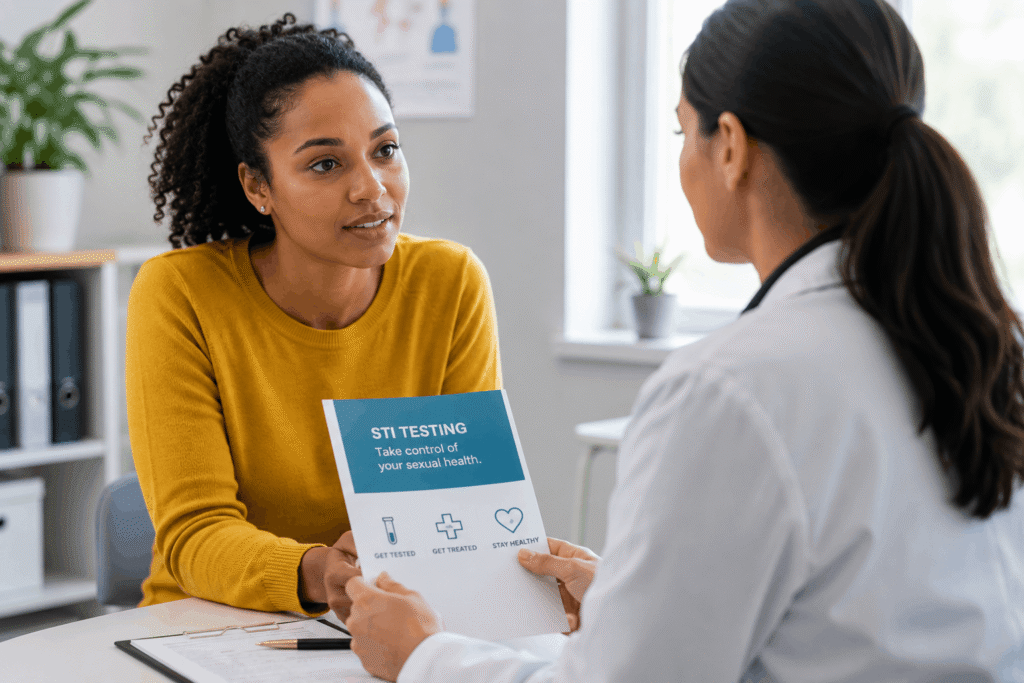
Are you searching online for a “STI/STD test near me”? Or perhaps you were wondering “where to get STI & STD tested?” without having to experience the wait, the awkwardness, or the worry about who might see you in a waiting room? You’re not alone. Sexual health is still one of the most under-discussed areas of healthcare, even though getting tested is one of the simplest, most responsible things you can do for yourself and anyone you’re intimate with.
At Friends Medical Service, a private sexual health clinic with locations across Northern Ireland, we treat sexual health screening exactly the way we treat a blood pressure check or a cholesterol test, i.e., as a normal, judgement-free part of looking after yourself.
This guide covers what STIs actually are, why regular testing matters, what happens during a screening and how to access fast and confidential STI and STD testing near you.
What Is an STI?
A sexually transmitted infection (STI) is passed from one person to another through sexual contact, whether that be vaginal, anal, or oral sex and, in some cases, through skin-to-skin contact alone. Common STIs include:
- Chlamydia
- Gonorrhoea
- Syphilis
- Herpes (HSV-1 and HSV-2)
- HIV
- Trichomonas vaginalis
- Mycoplasma genitalium
What’s the tricky part about STIs? Many of them don’t cause obvious symptoms, particularly in the early stages. Chlamydia, for example, is often symptomless, especially in women, yet left untreated it can lead to pelvic inflammatory disease and fertility problems. This is exactly why routine testing matters more than waiting for something to “feel wrong.”
Why Regular STI Testing Matters
Booking a private STI test isn’t just about identifying a problem, it’s about staying ahead of it and being proactive. Regular checks allow you to:
- Catch infections early, often before symptoms appear, allowing for prompt, straightforward treatment
- Reduce the risk of long-term complications, including infertility, pelvic inflammatory disease and in rare cases certain cancers linked to untreated HPV
- Protect your partners, since knowing your status means you can take the right precautions
- Provide genuine peace of mind, which matters just as much as the physical health benefit
If you’re sexually active (particularly with a new partner, multiple partners, or inconsistent protection) testing on a regular basis should simply be part of your healthcare routine, in the same way a smear test or annual check-up would be. Take a look at our sexual health service for the full list of what’s covered or pair a screening with a broader blood testing and health check if you’d like a fuller picture of your overall health at the same time.

How Common Are STIs in Northern Ireland?
STI rates across Northern Ireland have followed the same broad trend seen across the rest of the UK, with chlamydia and gonorrhoea remaining among the most commonly diagnosed infections, particularly in younger adults. Public Health Agency data consistently shows that a meaningful proportion of people diagnosed had no symptoms at all before testing.
This isn’t something happening “elsewhere.” Rather, it’s a normal, ongoing part of public health here, which is exactly why having access to STD clinics in Northern Ireland matters throughout the region, not just in Belfast. Whether you’re based in the capital and searching for a sexual health clinic that you can reach easily, or you’re closer to our Lurgan, Limavady, or Londonderry clinics, confidential testing is always within reach.
What Happens During an STI Test?
One of the biggest barriers to testing is simply not knowing what to expect. In reality, the process is far less daunting than people assume.
At Friends, an appointment starts with a private, 15-minute face-to-face consultation with one of our GPs, such as Dr Nour, who leads much of our sexual health work. Your GP will talk through your sexual history, any symptoms or concerns and which tests are appropriate for your situation. Not everyone needs every test and your GP will tailor the panel to you rather than running a blanket check.
Depending on what’s discussed, testing may include:
- Chlamydia and gonorrhoea
- Syphilis
- Herpes simplex I and II
- Trichomonas vaginalis
- Mycoplasma and ureaplasma species
- HIV (1&2/p24 antigen); private HIV testing is available as part of, or separate from, a full panel
- Hepatitis B and C
Samples are usually taken via urine test, swab, or blood test depending on what’s being checked. None of it is invasive or time-consuming and our clinical team will explain exactly what’s happening at every stage, making us one of the more straightforward options if you’re looking for STD testing fast and without a long wait for an appointment.
Are STI Tests Confidential?
Yes. We understand that privacy concerns stop a lot of people from getting tested altogether. Every consultation at our private STI clinic is conducted away from your usual GP practice if that’s your preference and you do not need a referral to book as you can arrange an appointment with us directly.
Getting Your Results
Once your samples have been processed, your GP will discuss your results with you directly and confidentially. If a result comes back positive, you won’t be left to figure out next steps alone. Treatment options will be explained clearly and where necessary, we can guide you through the process of informing partners so they can get tested too.
The vast majority of STIs are straightforward to treat, particularly when caught early and some, including HIV, can be very effectively managed with modern medication even though they aren’t curable. If speed matters to you, ask our team about turnaround times when you book. While not every test can be processed on the spot, we aim to keep the process as close to a same day STD test experience as clinically possible, with results communicated as quickly as lab processing allows.
Myths vs Facts About STIs
Misinformation is one of the biggest reasons people delay testing. Clearing up a few common myths can make booking feel a lot less daunting.
- Myth: You can tell if someone has an STI just by looking at them.
- Fact: Most STIs cause no visible signs at all, especially early on. Testing, not appearance, is the only reliable way to know your status.
- Myth: If you don’t have symptoms, you don’t have an STI.
- Fact: Chlamydia, gonorrhoea and even HIV can be present for months or years without noticeable symptoms. Many people are only diagnosed through a routine check.
- Myth: You can only catch an STI through penetrative sex.
- Fact: Some infections, including herpes and HPV, can pass through skin-to-skin contact alone. Oral sex also carries a real risk of transmission for infections like gonorrhoea and syphilis.
- Myth: Once you’ve tested negative, you’re set for good.
- Fact: A negative result only reflects your status at the time of testing. New partners or unprotected sex afterwards reset your risk. Regular testing, not a single test, is the safer approach.
- Myth: STIs are rare and unlikely to affect “people like me.”
- Fact: STIs don’t discriminate by age, background, or relationship status. Anyone sexually active can be exposed.
- Myth: Getting tested is a long, invasive and embarrassing process.
- Fact: Testing is quick, private and handled with the same professionalism as any other GP appointment.
STIs and Long-Term Relationships
It’s a common assumption that STI testing is only relevant to people who are single or dating casually. In reality, plenty of people in long-term, monogamous relationships have never actually been tested together, often because both partners assume the other has been tested at some point, or because it simply hasn’t come up.
A few things worth bearing in mind if you’re in a settled relationship:
-
Some infections can lie dormant for years.
Herpes and HPV in particular can remain inactive for long periods before symptoms ever appear, meaning a past partner from years ago could still be relevant to your current health.
-
Consider testing before stopping contraception.
Couples planning a pregnancy, or moving away from condoms, often overlook that condoms were also providing STI protection, not just contraception.
-
Testing together can be reassuring rather than accusatory.
Suggesting a test doesn’t need to imply mistrust. Many couples treat it as a shared health check.
-
Previous partners still count.
If either of you had partners before the relationship began, that history is still relevant to your current risk.
Framing testing as routine health maintenance, rather than a response to suspicion, usually makes the conversation much easier.

PEP and PrEP
For anyone concerned about a recent, specific exposure to HIV, or looking to reduce ongoing risk, two additional options exist:
-
PEP (post-exposure prophylaxis)
This is emergency medication taken after a potential exposure to HIV. It’s time sensitive and needs to start within 72 hours to be effective.
-
PrEP (pre-exposure prophylaxis)
This is taken on an ongoing basis by people at higher risk of HIV exposure, as a preventative measure.
If either of these is relevant to you, it’s best discussed directly with a GP as soon as possible.
When Should You Get Tested?
There’s no single rule that applies to everyone, but general good practice includes testing:
- After unprotected sex with a new partner
- If you or a partner has symptoms such as unusual discharge, pain, or sores
- Before starting a new sexual relationship
- As part of routine health maintenance if you have multiple partners
- If a partner tells you they’ve tested positive for an STI
If in doubt, testing is rarely the wrong call. It’s a quick, private way to rule things out or catch something early. It can also be a natural addition to any routine medical check-up you already have booked.
Frequently Asked Questions
Where can I get a private STI test near me in Northern Ireland?
Friends Medical Service offers confidential STI and STD testing at our Lurgan, Limavady and Londonderry clinics. You don’t need a referral as you can book directly with us as your private STD clinic of choice.
How fast are STI/STD test results?
Turnaround depends on the specific test, since some samples are lab-processed. We aim to make the overall experience as close to a “same day results” process as clinically possible and your GP will confirm expected timings when you book.
Is private STI testing confidential?
Yes. Every consultation is private, away from your usual GP practice if you prefer and handled with full discretion from booking through to results.
Do I need a referral for a private STI clinic?
No. You can book an appointment directly with us, so no referral from your own GP is required.
Can I get tested for HIV specifically?
Yes, private HIV testing is available either as a standalone test or as part of a broader sexual health panel, depending on what’s most relevant to you.
What’s the difference between an STI and an STD?
The terms are often used interchangeably. “STI” (Sexually Transmitted Infection) refers to the presence of an infection, which may or may not cause symptoms, while “STD” (Sexually Transmitted Disease) traditionally refers to cases where an infection has progressed to cause noticeable disease. In everyday online searches both terms generally point to the same testing process.
How often should I get tested?
This depends on your circumstances, but as a general guide: after any new partner, after unprotected sex, or at least annually if you’re regularly sexually active with more than one partner.
Further Reading
If you’d like to read more from independent, patient-focused sources before your consultation, the following are reputable places to start:
- NHS: Sexually transmitted infections (STIs),
- Terrence Higgins Trust: sexual health information,
- Sexual Health NI: Public Health Agency,
- Family Planning Association (FPA): Sexual Health Questions.
These sources are useful for general background reading, but they can’t replace a one-to-one assessment of your own medical history; that’s best done with your consultant.
Booking Your Appointment
At Friends Medical Service, sexual health screening is available as a private, confidential 15-minute GP consultation, with STI tests charged separately depending on what’s needed. As a trusted private sexual health clinic, we offer appointments across our Lurgan, Limavady and Londonderry locations, with easy access whether you’re travelling from Belfast or elsewhere in Northern Ireland.
Looking after your sexual health shouldn’t feel like a big deal, nor should it carry any taboos or other unnecessary mental burdens. It’s a normal part of taking care of yourself and we’re here to make the process as simple, private and judgement-free as possible.
Ready to book? Book your sexual health appointment online or call us to speak to our team directly. You can also read more on our blog or find out more about our approach to private healthcare in Northern Ireland.