
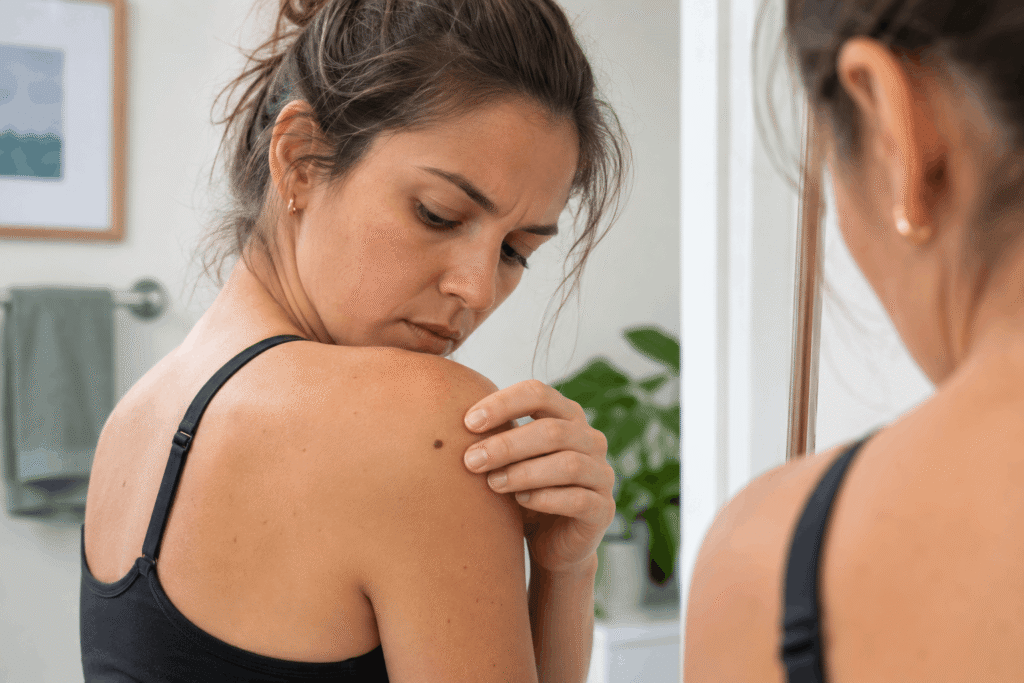
A mole that starts to itch or feel sore gets noticed in a way that a quiet mole never does. An itchy mole is not proof of a problem, but the National Health Service (NHS) lists itching and pain among the reasons to see a general practitioner (GP) about a mole, so the sensible move is to look closely and arrange an examination. This guide explains why itchy moles and sore moles happen, which warning signs matter most, what you can do at home and what to expect from a private mole check at Friends Medical Service in Lurgan.
Why Moles Itch or Become Sore
A mole (or naevus) is a cluster of pigment-producing cells that sit together in one spot on the skin. Our complete guide to moles covers how moles form and how to screen your own skin. This article focuses on the symptom itself: what an itchy mole or a sore mole might be telling you.
Skin carries a dense supply of nerve endings and a mole is part of that skin. Anything that irritates the surface or inflames the tissue beneath can make a mole itch or hurt. Many causes are mechanical or environmental. Others sit inside the mole itself, which is why an itchy mole or a sore mole deserves attention rather than a shrug. The same symptom can have a harmless cause in one person and a meaningful one in another, so it helps to know the full range.
Everyday Causes of an Itchy Mole
An itchy mole can follow ordinary irritation. Common triggers include:
- Friction from a bra strap, waistband, collar or watch strap rubbing the same spot
- Razor contact, where shaving over or close to a raised mole nicks or irritates it
- Dry or inflamed skin around the mole, including patches of eczema
- Sunburn or peeling after sun exposure
- Sweat and heat trapped under clothing in warm weather
- Insect bites close to the mole
- Fragranced soaps, lotions or washing powder that irritate the surrounding skin
Removing the trigger can settle the itch within days. If the itch keeps returning with no clear cause, that pattern is worth reporting to a clinician.
Why a Mole Becomes Sore
A sore mole can follow a knock, a scratch or repeated rubbing. The British Association of Dermatologists (BAD) notes that moles may become sore and inflamed after trauma. A mole that has caught on a zip or been picked at can stay tender while it heals. Raised moles on the neck, shoulders, back and waistline are more exposed to rubbing and knocks than flat moles in sheltered spots.
When Itching or Soreness Points to Something More Serious
Here the picture is less comfortable. The NHS describes moles that are swollen and sore, itchy, bleeding or crusty as signs to watch for alongside changes in size, shape or colour. Cancer Research UK adds a balancing point: most melanomas do not cause pain or itching, while some non-cancerous moles do. That means the symptom alone cannot settle the question in either direction. An itchy mole can prove harmless and a melanoma can arrive without any itch at all, which is exactly why symptoms are a prompt for an examination rather than a diagnosis.

Warning Signs to Check Alongside an Itchy Mole or Sore Mole
When a mole itches or hurts, look at the mole itself. The standard checklist is known as ABCDE:
- Asymmetry: one half of the mole does not match the other
- Border: the edge is ragged, notched or blurred rather than smooth
- Colour: more than one shade or an uneven mix of browns, blacks, reds or whites
- Diameter: wider than about 6mm, roughly the size of a pencil eraser (melanomas can be smaller, so size alone never rules anything out)
- Evolving: any change in size, shape, colour or how the mole feels
Of the five, change carries the most weight. A mole that has looked the same for years and itches after a sunburn is a different situation from a mole that has altered over recent weeks. Our guide to skin cancer awareness in Northern Ireland explains the ABCDE check in more depth.
Other signs worth noting alongside an itchy mole or sore mole:
- Bleeding without an injury
- Crusting, weeping or scabbing
- Redness or inflammation around the mole
- Swelling of the mole
- A new mole appearing in adulthood
- A mole that looks different from the others on your body, sometimes called the “ugly duckling” sign
- A new or unusual mark on the skin that has not gone away after a few weeks
Irritation or Warning Sign? A Quick Comparison
| Feature | Fits simple irritation | Reason to book promptly |
|---|---|---|
| Timing | Started after a clear trigger such as sunburn, a new strap or a razor nick | Appeared with no clear trigger or keeps returning |
| Appearance | Looks the same as before | Changed in size, shape, colour or border |
| Surface | Smooth or mildly red from rubbing | Bleeding, crusting or weeping without an injury |
| Sensation | Itch eases within days of removing the trigger | Itching or soreness persists or worsens |
| Comparison | Matches your other moles | Looks different from your other moles |
Treat the table as a way of organising your thoughts about an itchy mole rather than a way of diagnosing yourself. A mole in the right-hand column needs examination. A mole in the left-hand column still deserves a check if the itch or soreness lingers, because NHS advice is to see a GP about any mole that is painful or itchy.
What to Do When a Mole Itches or Feels Sore
If you have an itchy mole or a sore mole right now, take these steps in order:
- Stop scratching and picking. Scratching inflames the mole and the skin around it and it makes bleeding or crusting harder to interpret.
- Remove the likely trigger. Change the strap, loosen the waistband, switch to a fragrance-free wash or use an electric trimmer instead of a razor near the mole.
- Care for the skin around it. Apply a plain, fragrance-free moisturiser to dry skin nearby and keep the mole itself clean and dry.
- Photograph the mole. Use good light and place a coin or ruler beside it for scale. Take a second photograph a few weeks later so you can compare.
- Write down the details. Note the date the itch or soreness began and anything else that has changed.
- Book an examination. The NHS advises seeing a GP for a mole that is painful or itchy, so there is no need to wait for a set period to prove that it is serious.
If you would like a doctor to look at it, you can book a private GP appointment or read about skin concerns seen by our private GPs. A clear photo can help an online appointment with simple skin queries, although painful or changing skin is better seen in clinic. Our online GP service can give first-step advice when travel is difficult.
What Not to Do
- Do not use home mole removal kits, acids or creams sold for removing moles
- Do not freeze, burn or cut a mole at home
- Do not shave over a raised mole that is already sore
- Do not rely on photographs from the internet for reassurance about your own mole
Removal methods that destroy tissue leave nothing to test, so any lesion that worries you needs assessment first. Removal, where it is advised, should allow the tissue to be sent for laboratory examination.
Who Should Be Especially Careful
Some people have more reason to take an itchy mole or sore mole seriously. Risk rises with:
- Fair skin that burns rather than tans
- A history of sunburn, particularly in childhood
- Sunbed use
- A large number of moles or several unusual-looking ones
- A close relative who has had melanoma
- A previous skin cancer
- Years of outdoor work such as farming, building or groundskeeping
Skin cancer is the most common cancer in Northern Ireland and ultraviolet (UV) light passes through cloud, so a damp climate gives no protection. Care in the Sun, the Public Health Agency programme for Northern Ireland, publishes sun safety advice that suits local conditions.
When to See a Doctor About a Mole
Arrange an appointment if you notice any of the following:
- An itchy mole or sore mole that persists or keeps coming back
- A mole that has changed size, shape or colour
- Bleeding, crusting or inflammation with no injury to explain it
- A new mole appearing in adulthood
- A mole that looks different from the rest
- A dark streak or patch under a nail that an injury does not explain
Knowing when to get a mole checked removes a lot of the worry. Do not wait to see whether an itchy mole settles on its own. If a GP suspects skin cancer, they can arrange an urgent referral to a specialist. The NHS is clear that an urgent referral does not mean you definitely have cancer. If you need to be seen quickly, our same-day private GP service offers appointments in Lurgan and walk-in patients can take the earliest available GP slot that day during normal service hours.
What Happens at a Mole Check at Our Lurgan Clinic
A private mole check at Friends Medical Service is a full body mole check by a clinician, with extra attention paid to your itchy mole or sore mole. No GP referral is needed and you can bring photographs of how the mole looked before the itching started.
During the appointment
- The clinician examines your moles, using a dermatoscope where it helps
- You point out any itchy mole, sore mole or changing mole that has been worrying you
- A full-body check takes 20 to 30 minutes depending on how many moles need examining
After the appointment
- You are told clearly what was found and what happens next
- Where a mole should be removed, we can arrange this at our Lurgan clinic
- Where specialist referral is appropriate, we arrange it
- Nothing is removed on the day unless you have agreed and it is clinically appropriate
Please note that we offer mole checks but not mole mapping. Your clinician can advise whether mapping is worth pursuing elsewhere. We are also not a dermatology or skin cancer treatment centre. Where a lesion looks suspicious, the priority is getting you into the right specialist pathway quickly. Pricing depends on whether you are having a single mole assessed or a full-body check and we confirm the cost when you book.
Mole Removal for an Itchy or Sore Mole
Some people want an itchy mole removed because it keeps catching on clothing or a razor and has become a daily irritation. Others are advised to have a mole removed because of what the examination found. Both are valid reasons and assessment always comes first.
Private mole removal at our Lurgan clinic follows a set pattern:
- A clinician examines the mole and advises whether removal is appropriate
- Local anaesthetic numbs the area, so you feel pressure rather than pain
- The mole is excised or shave-excised where that suits its type and position
- The wound is closed and dressed, with stitches where needed
- Tissue is sent for histology where clinically indicated, so you receive a confirmed answer rather than an assumption
- You go home the same day with written aftercare advice
Our minor surgical procedures service is delivered by our consultant surgical team, including Mr Abid Rashid, Consultant Plastic Surgeon and Mr Muhammad Yousuf, Consultant General Surgeon. Moles on the face receive particular care over technique and incision placement and your clinician will talk through the likely scar before you decide. The price is confirmed at your consultation before any procedure goes ahead. Our patient guide to minor surgical procedures explains how moles, skin tags, lipomas and ganglion cysts differ.
How Friends Medical Service Can Help
| Route | Best for | Where | Referral needed | Cost |
|---|---|---|---|---|
| Mole check | An itchy or sore mole, changing moles or peace of mind | Lurgan clinic | No | Confirmed when you book |
| Private GP appointment | A first opinion on any skin change | Lurgan clinic or online | No | From £70 in clinic, online from £55 |
| Mole removal | A mole that needs removing after assessment | Lurgan clinic | No | Confirmed at consultation |
Our Lurgan clinic serves patients from across Craigavon, Portadown, Lisburn, Banbridge, Armagh, Belfast and the wider Northern Ireland area. Our Limavady and L/Derry clinics provide No Scalpel Vasectomy appointments only, so mole checks and mole removal take place in Lurgan. If you would like to meet our doctors first, you can read about Dr Abdel Nasir Nour or browse our full consultants directory. The Friends Medical GP site also explains what to expect at your first private GP appointment.
Frequently Asked Questions
What does an itchy mole mean?
An itchy mole means that the mole or the skin around it is irritated or inflamed. Friction, dryness, sunburn and insect bites can all cause an itchy mole and so can a change inside the mole. Because an itchy mole alone cannot separate harmless irritation from a warning sign, the NHS advises seeing a GP about any mole that is itchy or painful.
How long should an itchy mole take to settle?
An itchy mole with a clear trigger such as a rubbing strap or a razor nick can settle within days once the trigger is gone. An itchy mole that persists beyond that, returns without a trigger or comes with any change in appearance needs examining. There is no need to wait for a set period before booking.
Is a sore mole more serious than an itchy mole?
Neither symptom ranks above the other. The NHS lists both among the signs worth watching and both can have harmless causes. The features that carry the most weight are changes in the mole itself: size, shape, colour or border.
Is an itchy mole always a sign of skin cancer?
No. Cancer Research UK states that most melanomas cause no itching or pain and that some harmless moles do itch. An itchy mole therefore proves nothing in either direction. What matters is the whole picture: whether the mole has changed, how it looks beside your other moles and whether the itch persists. An examination is the only reliable way to tell.
Why is my mole sore to touch?
A knock, a scratch, rubbing from clothing or a razor nick can all make a mole tender and the British Association of Dermatologists notes that moles may become sore and inflamed after trauma. A sore mole with no clear cause or one that stays tender after the skin has healed, should be examined.
Should I see a doctor about an itchy mole if I think it is only irritation?
Yes, if the itch persists or returns. The NHS advises seeing a GP for a mole that is painful or itchy and sets no waiting period. A short appointment gives you either reassurance or an early start on the next step and both are worth having.
Can dry skin or eczema make a mole itch?
Dry skin or eczema around a mole can make the whole area itch, including the mole. If the itch settles when the surrounding skin is treated and the mole looks unchanged, irritation becomes the more likely explanation. A mole that itches while the skin around it feels normal is a stronger reason to book a check.
Can I put cream on an itchy mole?
A plain, fragrance-free moisturiser on the dry skin around the mole is reasonable. Check with a clinician before applying medicated creams directly to the mole, because treating the symptom can hide a change that needs examining. Never use products sold for removing moles at home.
Do I need a GP referral to book a mole check?
No. You can book a private mole check at our Lurgan clinic directly. If the clinician finds something that needs specialist input beyond what we provide, we explain the next step clearly and arrange onward referral.
Will a mole check tell me whether my mole is cancerous?
A clinician examines the mole, uses a dermatoscope where it helps and advises what should happen next. Examination alone does not give a definitive tissue diagnosis. Where removal is clinically indicated, the tissue is sent for histology so that you receive a confirmed answer rather than an assumption.
Does Friends Medical Service offer mole mapping?
No. We offer full-body mole checks but not mole mapping. Your clinician can advise during the appointment on whether mole mapping is worth pursuing elsewhere, particularly if you have many moles or a family history of skin cancer.
Can an itchy or sore mole be removed?
Yes, after assessment. Every mole is examined before any decision is made and removal takes place under local anaesthetic at our Lurgan clinic. Where there is a clinical reason, the removed tissue goes for histology. Ask about testing before you agree to any removal method. If the lump turns out to be a skin tag instead, our skin tag removal service may be the better fit.
Can patients from the Republic of Ireland book a mole check?
Yes. We welcome cross-border patients and many travel to Lurgan for mole checks and removal. Our cross-border patients page explains how it works.
Further Reading
If you’d like to read more from independent, patient-focused sources before your consultation, the following are reputable places to start:
- NHS: Moles – an overview of moles and the changes that should prompt a visit to your GP
- NHS: Symptoms of Melanoma Skin Cancer – the signs of melanoma, including itchy, sore, bleeding and crusty moles
- Cancer Research UK: Melanoma Symptoms – a clear explanation of the ABCDE checklist and when itching or pain matters
- nidirect: Skin Cancer (Melanoma) – Northern Ireland guidance on spotting melanoma and what happens after a GP visit
- British Association of Dermatologists: Patient Information Leaflets – dermatologist-written leaflets, including one on moles
- Melanoma Focus: About Melanoma – guidance from the UK melanoma charity on checking your skin
These sources are useful background reading and complement, rather than replace, a proper clinical assessment of your own skin.
Final Thoughts
An itchy mole or sore mole is a good reason to look at your skin and a check costs you one appointment. Whatever the cause turns out to be, you leave knowing what is going on and what, if anything, comes next.
To get an itchy mole or sore mole examined by a clinician, book a mole check at our Lurgan clinic or book a private GP appointment. If you prefer to speak to our team first, get in touch through our contact page or book online with Friends Medical GP.