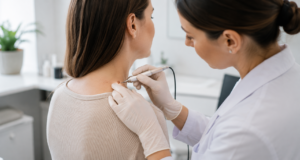

Skin tags, lipomas, ganglion cysts and unusual moles are among the most common reasons people book a consultation with a surgeon. None of these conditions are usually dangerous, but they can be uncomfortable, unsightly, or simply a source of worry and many patients want them assessed or removed. This guide explains what minor surgical procedures involve, why these growths and lumps develop and what to expect if you decide to have one treated.
What Are Minor Surgical Procedures?
Minor surgery covers a range of small operations that are usually carried out under local anaesthetic, often within a single outpatient visit. Unlike major surgery, minor operations don’t typically require a general anaesthetic, an overnight hospital stay, or a long recovery period. Most patients are able to go home the same day and resume normal activities within a short time.
Common types of minor surgical procedures include:
- Skin tag removal
- Lipoma removal
- Ganglion cyst removal
- Mole removal
- Mole checks and mole mapping
- Removal of other skin lesions
At Friends Medical Service, our surgical services cover nearly all of the above (we are currently unable to provide ganglion cyst removal service anymore, but this will soon be addressed; also, we only offer mole checks but not mole mapping services), giving patients a straightforward route from initial assessment through to treatment, without a long wait for an NHS referral.
Skin Tags: What They Are and Why They Appear
What Is a Skin Tag?
A skin tag, sometimes called a cutaneous tag or a flesh tag, is a small, soft growth of skin that hangs off the surface by a thin stalk. They’re harmless and made up of collagen fibres and blood vessels covered by skin. Most people will develop at least one skin tag at some point in their life and it’s common to have several.
What Causes Skin Tags?
The exact reason skin tags form isn’t fully understood, but they’re generally linked to friction, where skin repeatedly rubs against skin or clothing. This explains why skin tags on the neck, under the armpit, around the groin and under the breasts are so common.
Recognised skin tag causes and risk factors include:
- Skin-on-skin friction, particularly in body folds
- Being overweight or having a higher BMI
- Pregnancy, due to hormonal changes and weight gain
- Insulin resistance and type 2 diabetes
- Getting older, as skin tags become more common with age
- A genetic tendency, since they can run in families
If you’re asking yourself “why am I getting skin tags all of a sudden,” a change in weight, a new pregnancy, or an underlying metabolic change such as insulin resistance are usually the first things worth considering. There are also certain diseases that cause skin tags to appear in greater numbers, including diabetes and, less commonly, some hormonal conditions, so a sudden increase is sometimes worth mentioning to a clinician.
Types of Skin Tags
Skin tags vary quite a bit in size and appearance. Kinds of skin tags patients commonly ask about include:
-
Small skin tags:
- Tiny, barely noticeable growths, often the first to appear.
-
Large or big skin tags:
- Some grow to a centimetre or more and can catch on clothing or jewellery.
-
Massive skin tags:
- Larger, more established growths that have been present for years.
-
Skin tags on the neck:
- Among the most common and most visible.
-
Armpit skin tags:
- Frequent due to friction and skin-on-skin contact.
-
Facial skin tags:
- Often around the eyelids, where removal needs extra care.
Are Skin Tags the Same as Warts or Moles?
Skin tags are often confused with warts and moles, but they’re different. Warts are caused by a viral infection (HPV) and tend to have a rougher, textured surface, whereas a skin tag is smooth and soft. Moles are flat or raised pigmented spots that develop from clusters of pigment cells, rather than loose folds of skin. If you’re unsure whether a growth is a skin tag, a wart, or a mole, a clinical assessment is the safest way to find out.
Can Skin Tags Be Cancerous and Do They Go Away on Their Own?
Skin tags are benign and turning cancerous is not a recognised feature of a skin tag. That said, any new or changing skin lesion should be looked at by a clinician to confirm what it actually is, since some skin cancers can be mistaken for a tag in the early stages.
Skin tags don’t tend to disappear by themselves. Occasionally one may twist on its stalk, lose its blood supply and fall off, but most skin tags stay as they are indefinitely unless removed. A sore skin tag, an infected skin tag, or one that’s become red, itchy or irritated is a common reason patients choose to have it removed rather than wait.
Skin Tag Removal
Removing a skin tag is a quick, minor procedure. Depending on size and location, it may be removed by cutting, cauterisation, or ligation, usually under local anaesthetic with minimal discomfort. Our skin tag removal service covers tags on the neck, armpits, eyelids and elsewhere on the body, generally in a single appointment.
Lipomas: Soft Lumps Under the Skin
What Is a Lipoma?
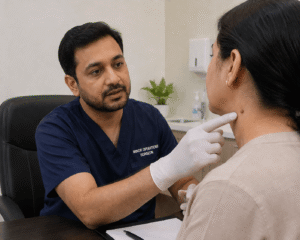
A lipoma is a soft, slow-growing lump that develops just beneath the skin. In simple terms, a lipoma’s meaning is a benign tumour made of fat cells and it’s one of the most common types of soft tissue lump found in adults. Lipomas are usually soft to the touch, move slightly under the skin when pressed and grow slowly over months or years.
What Causes Lipomas?
The precise reason for lipoma formation isn’t fully understood, but several factors are associated with them:
- Genetics, as lipomas often run in families
- Being between 40 and 60 years old, the age range where they most commonly appear
- Certain inherited conditions, such as familial multiple lipomatosis
- Minor trauma to an area of tissue in some cases
When Should a Lipoma Be Removed?
Most lipomas are left alone if they’re not causing problems. Removal is usually considered when a lipoma is growing, becoming painful, pressing on a nerve, restricting movement, or simply causing self-consciousness. Removal typically involves a small incision under local anaesthetic to take out the fatty lump intact. Full details on the procedure, aftercare and what’s involved are on our lipoma removal page.
Ganglion Cysts
A ganglion cyst is a fluid-filled swelling that develops along a tendon or joint, most often at the wrist or hand, though they can also appear at the knee or foot. The cause of a ganglion cyst isn’t always clear, but they’re thought to form when joint or tendon fluid leaks out and collects in a small sac. Repetitive movement or previous joint irritation may play a role, which is why a ganglion cyst at the knee, for instance, sometimes develops after activities that put repeated strain on the joint.
Ganglion cysts are benign and sometimes shrink or disappear without treatment. Where a cyst is painful, restricts movement, or is pressing on a nerve, removal may be recommended. Please note that, while Friends Medical Service has previously provided this service, we are currently unable to continue to do so, but this is something that we may be reintroducing in the future.
Moles and Skin Lesions
Understanding Moles
Moles are extremely common and most people have several. They can be flat or raised and range from pale pink to dark brown or black. While the vast majority of moles are entirely harmless, changes in size, shape, colour or texture are the main warning signs that a mole should be checked.
When to Get a Mole Checked
You should have a mole checked if you notice:
- Asymmetry, where one half of the mole doesn’t match the other
- An irregular or blurred border
- Uneven or changing colour
- A diameter larger than around 6mm
- Any evolution in size, shape, or symptoms such as itching or bleeding
Mole Checks and Mole Mapping
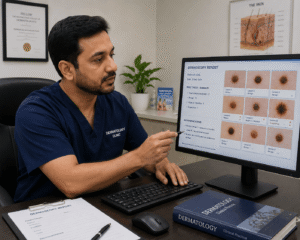
A mole check involves a clinician examining any moles you’re concerned about, often using dermoscopy to look more closely at the structure of the skin. Mole mapping goes a step further, creating a photographic record of your moles so that any future changes can be tracked over time. This is particularly useful for anyone with a large number of moles, a family history of skin cancer, or moles that are difficult to keep an eye on alone. Details on our full-body mole check service are available on our mole checks service page (please note that we do not offer mole mapping, only mole checks).
Mole Removal
Where a mole needs to come off, whether for medical reasons or because it’s a nuisance, removal is carried out under local anaesthetic and the tissue is sent for histology where clinically appropriate. This applies to moles anywhere on the body, including facial mole removal, where extra care is taken given the visibility of the area. You’ll find more information on our mole removal page.
What to Expect on the Day of a Minor Surgical Procedure
Minor operations are generally straightforward, but knowing what to expect can help ease any nerves. A typical visit follows this pattern:
- Consultation and assessment: the area is examined and the appropriate procedure is discussed and agreed with you.
- Local anaesthetic: the skin around the area is numbed, so the procedure itself is generally not painful.
- The procedure: depending on what’s being removed, this may take anywhere from a few minutes to around half an hour.
- Dressing and aftercare advice: the site is dressed and you’re given guidance on caring for it as it heals.
- Follow-up: for anything sent for histology, such as a mole, you’ll be given the results once available.
Most patients are able to drive and return to normal activities the same day, though some procedures may come with specific advice depending on the site and size of what’s removed.
Choosing a Surgeon for Minor Surgery
Having a minor procedure done by an experienced surgeon matters, even for something as small as a skin tag or a mole. At Friends Medical Service, minor surgical procedures are carried out by consultant surgeons, including Mr Muhammad Yousuf and Mr Abid Rashid, giving patients access to consultant-level care without a lengthy NHS waiting list. You can find out more about the full range of procedures on offer and book an appointment, through our surgical services page.
Frequently Asked Questions
Why do you get skin tags?
Skin tags are mainly linked to friction between skin folds, along with factors such as weight, pregnancy, insulin resistance and age. A genetic tendency can also make them more likely.
Do skin tags fall off on their own?
Occasionally, but it’s uncommon. Most skin tags remain unless they’re removed and a twisted or irritated tag is often what prompts people to seek removal.
Can skin tags be cancerous?
No, skin tags are benign growths. Any new or changing skin lesion should still be assessed to confirm exactly what it is.
What is a lipoma made of?
A lipoma is made up of fat cells enclosed in a thin capsule, sitting just under the skin.
How much does mole or skin tag removal cost?
Cost depends on the number, size and location of what’s being removed, along with whether histology is needed. A consultation will give you an accurate quote for your specific case.
What causes a ganglion cyst?
Ganglion cysts form when fluid from a joint or tendon leaks and collects in a small sac. Repetitive movement or joint strain may contribute, though the exact cause isn’t always clear.
How do I book a mole check near me?
You can book a mole check (not mole mapping) appointment through our surgical services page, where an experienced clinician will assess any moles you’re concerned about.
Further Reading
If you’d like more background from independent, patient-facing sources, the following are reputable places to start:
- NHS: Skin Tags: an overview of what skin tags look like and when to seek advice
- NHS: Lipoma: general information on lipomas and when removal may be considered
- NHS: Ganglion Cyst: background on causes, symptoms and treatment options
- NHS: Moles: guidance on normal moles and sun protection
- NHS: Symptoms of Melanoma Skin Cancer: signs that a mole or skin lesion should be checked
- British Association of Dermatologists: Patient Information Leaflets: detailed, specialist-reviewed leaflets on a wide range of skin conditions
These sources are provided for general background reading and don’t replace a personal assessment with a clinician.
Getting Assessed
If you have a skin tag, lipoma or mole that you’d like looked at, the first step is a consultation with one of our surgeons. Whether it’s a routine mole check, assessment of a scar that hasn’t healed as expected, or removal of a lump that’s bothering you, our surgical services team can talk you through the options and arrange the right procedure for you.